






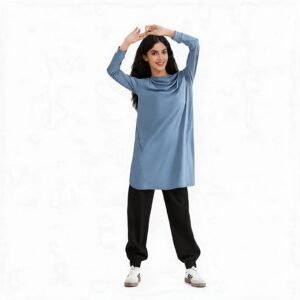


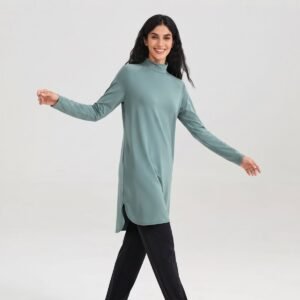


Modest Activewear Styles We Manufacture
Long-Sleeve Gym Set (Top + Leggings)
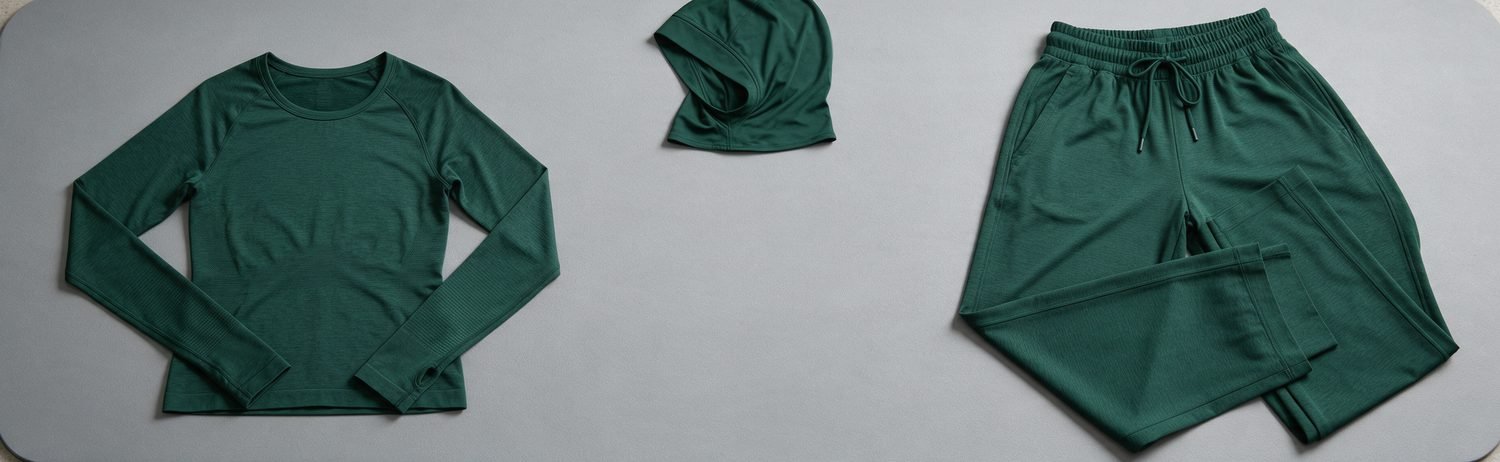
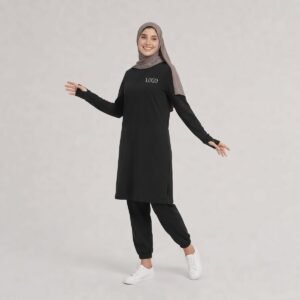
This is the volume product in modest activewear: a long-sleeve fitted or semi-fitted top with full-length high-waist leggings. Top length is where ranges go wrong. It has to sit below the hip for coverage without restricting the leg, and not bunch where it meets the waistband. That one measurement is what separates a factory that can develop fit from one that can only sew.
Construction: flatlock seams throughout for comfort and flat seam profile. Four-way stretch in both pieces. Waistband is bonded or stitched-and-turned — bonded gives a cleaner finish but cannot be let out; stitched-and-turned is more durable for high-stretch use. Thumb loop at cuff optional. Gusset panel at crotch for movement range.
Typical fabric: 88% polyester / 12% spandex or 80% nylon / 20% spandex, 200–240 g/m² for leggings; 170–200 g/m² for top.
Best for: gym, pilates, yoga and general fitness. UK, EU and Australian modest fashion brands.
Hooded Tracksuit / Jogger Set
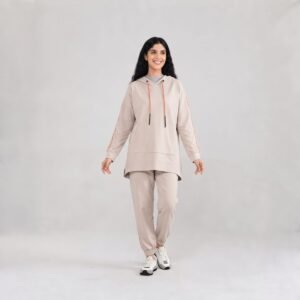
A zip-up or pullover hoodie with tapered or straight jogger trousers. It is the most versatile piece in the range — gym in the morning, school sport in the afternoon, casual wear the rest of the week. In Muslim markets it also sells hard at Ramadan, because it layers over prayer clothes and holds warmth in the cooler months.
Construction: French terry or loopback fleece for warmth; technical jersey for lightweight versions. Hoodie lining in performance mesh for ventilation. Adjustable hood drawstring. Jogger with elasticated waist and ankle cuffs. Zip pockets on hoodie standard; jogger side pockets optional.
Typical fabric: 80% cotton / 20% polyester French terry (casual tier) or 88% polyester / 12% spandex technical jersey (sport tier), 250–320 g/m².
Best for: casual and sport market crossover. Strong for UK and EU at-leisure and sportswear brands.
Sports Hijab
A head covering engineered for sport, not adapted from a fashion hijab: light, breathable, no long tail to catch, and it must not slip once the wearer starts moving. We build two constructions — a cap-style jersey hijab that covers the head and tucks under the chin, and an underscarf plus long-drape set for buyers who want more coverage. Both are moisture-wicking, and both have to come out of a full session still dry and odour-free.
Construction: cap hijab: one-piece knit construction with no seam at the crown (reduces pressure points). Face opening shaped to contour without restriction. Drape hijab: lightweight chiffon or jersey panel attached to a cap underscarf. Silicone inner band to prevent slippage on hairline.
Typical fabric: 95% polyester / 5% spandex performance jersey, 110–140 g/m². Drape options in woven chiffon or lightweight jersey.
Best for: standalone sports hijab brands, add-on to gym set collections, school and club sport.
Full-Coverage Running & Outdoor Set
Built for the street, not the studio: a windproof outer layer, optional high-visibility reflective print, and fabric that breathes but still resists weather. What separates it from an indoor gym set is weight, plus wind and light-rain resistance. The category overlaps hard with outdoor sports, and Muslim athletes running roads, cycling and hiking are asking for it more each season.
Construction: outer layer in bonded performance fabric with DWR (durable water repellent) finish. Inner layer moisture-wicking jersey for sweat management. Fitted hood. Reflective print panels on back and sleeves for road safety. Full-length YKK zip on jacket. Running tights with compression panel and reflective trim.
Typical fabric: 94% polyester / 6% spandex bonded knit with DWR, 160–190 g/m²; compression tight in 80% nylon / 20% spandex, 220–250 g/m².
Best for: outdoor and running brands, competitive sport, Muslim athlete market.
Modest Yoga & Pilates Set
Lower-intensity movement asks for different fabric and a different silhouette from high-output gym work. Yoga and pilates buyers buy on softness, stretch, opacity in every position — the downward-dog test is the real one — and a look that holds up in a studio as well as a gym. This sits at the top of the modest activewear price range, and it tends to attract buyers with real brand positioning behind them.
Construction: 4-way stretch with a minimum 50% recovery, so the fabric comes back to shape after a full session rather than staying stretched. Seamless or minimal-seam construction for the studio look. Wide waistband (8–10 cm) for comfort in floor poses, and a longer top hem with an optional tie-back for coverage when the wearer bends forward.
Typical fabric: 92% nylon / 8% spandex or bamboo-blend jersey (premium tier), 200–230 g/m². Buttery-soft finish preferred over performance-textured fabric for this category.
Best for: premium modest fashion brands, yoga studios, wellness and mindfulness-positioned activewear labels.
Colour-Block & Print Activewear
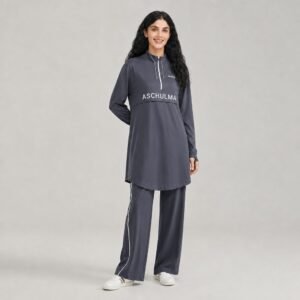
Colour-block panelling or all-over print, cut on our standard gym and tracksuit constructions. Bold colour and print photograph better than anything else in this category — it is the main reason social-media-led modest sportswear brands grow. The difficulty is doing it without breaking coverage. Contrast seams have to land in the right places, or the panelling draws an optical line exactly where the wearer does not want one.
Construction: colour-block panels cut and sewn with flatlock seams in matching or contrasting thread. Print options: sublimation print onto polyester/spandex (all-over), or fabric-level reactive print for natural blends. Panel placement reviewed at pre-production stage.
Typical fabric: sublimation-print 88% polyester / 12% spandex, 200–230 g/m² for gym sets; colour-block panels in same base fabric with separate fabric pieces.
Best for: social media-driven brands, Ramadan and Eid seasonal collections, fashion-forward modest activewear labels.
Wudu-Friendly Activewear (Water-Permeable Construction)
The smallest corner of the range and the hardest to engineer, which is why almost no general activewear factory engineers for it. A wudu-friendly garment lets the wearer perform ablution without taking it off. That means the fabric at the forearms and lower legs has to pass a real volume of water while still behaving like a performance knit everywhere else.
Construction: the mechanism is an engineered mesh structure, not a coating. We use an open-knit nylon/elastane mesh at the forearm and lower-leg panels with a water permeability target of ≥90%, tested by timed water pass-through rather than a visual check. Critically, the panel is a knit structure — a coating or laminated film would block water entirely, so a supplier offering “water-repellent” fabric here has misunderstood the brief. Mesh is placed only where it is needed; the torso and thigh keep the solid performance knit.
Typical fabric: 150–190 g/m² warp-knit power mesh at the permeable panels, 200–240 g/m² solid knit elsewhere, both from the same dye lot so panels match. The sleeve takes a non-elasticated cuff so it can be pushed up the forearm without deforming.
Best for: brands whose buyers pray during the day — gym, school and mosque-adjacent activewear collections. A feature almost no competing factory engineers for.