
Type “muslim woman’s garment” into Google and the first page is mostly Pinterest pins, stock photos and two crossword-solver sites. That tells you something: plenty of people want a name, and nobody has bothered to explain what the garments actually are, how they differ, or why the same word means different things in Jakarta, Riyadh and London.
We are ModestRise, a modest clothing manufacturer. We cut and sew abayas, jilbabs, khimars, hijabs, prayer dresses and burkinis for brands, so we see these garments from the pattern table rather than the shop floor. This guide explains each Muslim woman’s garment by what it covers, how it is built and where it is worn. If you only came for the crossword answer, it is at the bottom.
Key takeaways
- There is no single “Muslim woman’s garment”: the hijab covers the hair, the abaya and jilbab cover the body, and the niqab and burqa cover the face.
- The same word can mean different garments by country — in Indonesia and Malaysia, “jilbab” usually means a headscarf.
- Most Muslim women wear a headscarf with ordinary modest clothes; face coverings are worn by a minority.
- Muslim men wear their own traditional robe, the thobe (also called dishdasha, kandura or jubba).
By the ModestRise Team · Last updated: September 27, 2026
The short answer: there is no single “Muslim woman’s garment”
Islam asks for modest dress, but it does not prescribe one garment. What a Muslim woman wears depends on her country, her school of thought, her family and her own choice. The same Muslimah — the Arabic word for a Muslim woman — might wear a jersey hijab and jeans to work, an abaya to a wedding and a two-piece prayer set at home. Some Muslim women do not cover their hair at all.
The general principle most scholars agree on — the Islamic dress code in its simplest form — is clothing that is loose, not see-through, and covers the body apart from the face and hands. Every garment below is one regional or practical answer to that principle. The names overlap, and that is where most of the confusion comes from.
Muslim women’s garments at a glance
Here are the names of Muslim clothing for women — the traditional garments often grouped as Islamic female garb — and the practical differences between them.
| Garment | What it covers | Face | Construction | Most associated with |
|---|---|---|---|---|
| Hijab | Hair, ears, neck | Open | Rectangle or square scarf, wrapped and pinned | Worldwide |
| Instant hijab / al-amira | Hair, neck | Open | Inner cap joined to a tube or drape, pulled on | Worldwide, especially UK, US, Southeast Asia |
| Shayla | Hair, neck | Open | Long rectangular scarf wrapped around the head, often pinned at the shoulder | Gulf states |
| Khimar | Head, neck, shoulders, often chest to waist | Open | Cape-like piece that falls straight from the crown | Gulf, North Africa, Western converts |
| Abaya | Body from shoulders to ankles | Open | Loose robe, closed (over the head) or open-front | Gulf states, now worldwide |
| Jilbab | Head and body | Open | Full-length outer garment with an attached or matching hood | UK, Middle East; in Indonesia the word means a headscarf |
| Niqab | Face below the eyes | Covered, eyes visible | Face veil tied behind the head, worn with an abaya or jilbab | Gulf states, some communities worldwide |
| Burqa | Whole body including face | Covered, mesh over the eyes | One-piece outer covering from head to ground | Afghanistan, parts of Pakistan |
| Chador | Head and body | Open | Semicircle of fabric held closed by hand or tucked, no sleeves | Iran |
| Prayer dress | Everything except face and hands | Open | One-piece or two-piece set (khimar plus skirt) | Worldwide; called telekung or mukena in Malaysia and Indonesia |
| Burkini | Whole body except face, hands, feet | Open | Swim tunic or suit with hood, in stretch swim fabric | Worldwide |
Now the detail, garment by garment, including the things a photo on Pinterest will not show you.
Hijab: the headscarf most people mean
In everyday English, “hijab” means the headscarf that covers the hair, ears and neck and leaves the face open. In Arabic the word is broader and refers to modesty and covering in general, which is why you will hear scholars use it for more than a scarf.
A hijab looks like the simplest thing a factory can make: a rectangle of fabric with four edges. It is not. There is no lining to rescue a thin fabric and no seam to hide a mistake, so the whole product is the cloth and the edge. The two fabrics you will see most:
- Jersey stretches, grips the head and usually needs no pins. It survives the washing machine, which is why it is the everyday choice in most markets. Because jersey is a knit, the edge is overlocked rather than rolled.
- Chiffon gives the drape and movement people associate with a styled hijab and photographs well. It is light (60–90 g/m²), slippery and semi-sheer, so it is usually worn over an underscarf.
For styles, fabrics and how a rolled edge should look, see our hijab manufacturing page.
Instant hijab (al-amira): the pull-on version
An instant hijab is an inner cap and an outer tube or drape sewn into one piece, so it goes on in one movement with no pins. The older two-piece version, a cap plus a separate tube, is often sold as an “al-amira”. You will also see “pull-on hijab”, “slip-on hijab” and “one-piece hijab” for the same idea.
From the factory side, the part that decides whether an instant hijab works is the cap, not the pretty outer layer. A cap cut for one head size sits loose on a smaller head and slides back by midday. That is why the cap is usually a firmer 200–220 g/m² cotton jersey, while the outer layer can be chiffon, viscose or modal. There are also sports versions in quick-dry stretch fabric. More on the constructions on our instant hijab page.
Shayla: the Gulf wrap
A shayla is a long rectangular scarf, typically in chiffon or georgette, wrapped around the head and pinned at the shoulder. It is the headscarf you see most often worn with a black abaya in the UAE, Saudi Arabia and Qatar. It is a hijab in function; the name tells you the region and the wrapping style.
Khimar: the cape that falls from the crown
A khimar is often listed as a “long hijab”, but it is built differently. Instead of being wrapped, it drops in one line from the top of the head over the shoulders, and it comes in lengths that go from just past the shoulders to the chest, waist, hip and even the knee. The face opening is shaped so the fabric falls away from the face instead of resting on it.
Weight matters more on a khimar than on almost any other headwear. On a chiffon khimar we work to 75–80 g/m²: at around 60 g/m² it clings and loses its shape, and at around 90 g/m² it hangs stiffly and pulls back off the crown. Longer khimars are often made in an opaque crepe instead, so they do not need lining. Our khimar page covers the five length formats.
The word itself is loose. In Arabic, khimar simply means a covering or veil, and in some countries it is also used for a face veil, so when a seller or a customer says “khimar”, it is worth asking which garment they mean.
Abaya: the robe worn over clothes
An abaya is a loose, full-length robe worn over regular clothes when a woman goes out. Traditionally it is black and plain, and in the Gulf it is still mostly black. Elsewhere it now comes in every colour, cut and fabric. There are two basic families:
- Closed abaya. Goes on over the head, with a single clean front panel and no opening down the middle. It gives the most coverage and is the everyday garment across the Gulf.
- Open abaya. Opens down the front like a coat, closed with snaps, a belt or left loose over a dress. The open abaya is the most popular style with Western and Southeast Asian brands. The kimono abaya is an open abaya with wide, wing-like sleeves.
The fabric names you will see on abaya labels are worth knowing. Nida is a matte, medium-weight, fully opaque crepe and the standard Gulf abaya fabric. Korean crepe is softer and more wrinkle-resistant. Chiffon gives movement but needs lining.
One thing a weight number will not tell you is whether a fabric is see-through: a 150 g/m² nida in a dark colour is fully opaque, while a 150 g/m² chiffon is not, in any colour. For the full style list, see our abaya manufacturing page.
Jilbab: abaya plus hood, but not quite

In the UK and the Middle East, a jilbab is a full-length outer garment that covers the head as well as the body, either with an attached hood or with a headscarf cut from the same fabric.
People often call it “an abaya with a hood”, and that is exactly how a badly made one is produced: a hood stitched onto an abaya pattern. It ends up too flat or set too far back, and the coverage fails when the wearer walks or the wind catches it.
A properly made jilbab has the hood designed into the pattern from the start, with the front panel built to close over the chest. Fabrics lean towards structure, such as nida or Korean crepe, because a very drapey fabric opens at the front in motion. Front closures range from a zip running neckline to hem, to buttons and magnetic snaps.
One naming trap: in Indonesia and Malaysia, “jilbab” usually means a headscarf, closer to what English speakers call a khimar or hijab. If you are buying or selling across markets, check which garment the other side means. A long closed robe is also sold as a jubah in Malaysia and Indonesia. More on construction on our jilbab page.
Women who wear both often choose by body shape rather than by name. As one wearer put it on Reddit: “Jilbab actually accentuates the chest area for women with large chests. An abaya and khimar covers a lot better for many sisters.” (r/SistersInSunnah)
Niqab and burqa: the face coverings
These are the two face coverings most often confused in news coverage, and usually what people mean by the strictest Islamic covering for women.
- Niqab. A face veil that covers the face below the eyes, tied behind the head and worn with a headscarf and an abaya or jilbab. The eyes stay visible. It is most common in the Gulf states and among some women worldwide who choose it.
- Burqa (also spelled burka). A single outer garment that covers the whole body and the face, with a mesh panel over the eyes. It is strongly associated with Afghanistan and parts of Pakistan. Outside those regions it is rare, and many people who say “burqa” actually mean a niqab.
Only a minority of Muslim women wear either one. Whether face covering is required is debated among scholars, and the majority view is that it is not.
Survey data backs this up, with one big regional exception. A University of Michigan survey reported by Pew Research Center asked people in seven Muslim-majority countries which style of dress is most appropriate for a woman in public. A hijab covering the hair and ears was the top choice in Tunisia (57%), Egypt (52%), Turkey (46%) and Iraq (44%). Saudi Arabia was the outlier: 63% chose the niqab and a further 11% the burqa. In Lebanon, 49% said it was acceptable for a woman not to cover her hair at all.
Chador: the Iranian cloak
A chador is a large semicircle of fabric, usually black, that covers the head and body and has no sleeves or fastenings. It is held closed at the front by hand or tucked under the arm. It is the traditional outer garment in Iran and among Shia communities in Iraq and elsewhere, worn over a headscarf and ordinary clothes.
Prayer dress: the garment worn for salah

Many women keep a separate garment just for prayer, especially at home. It has one job: to keep the body covered through every position of salah, including bowing and prostrating with the forehead on the floor. The two common builds are a two-piece set, a khimar-style top plus a wide skirt, and a one-piece dress with the headpiece joined at the neckline. In Malaysia and Indonesia it is called a telekung or mukena.
When we look at why prayer dresses come back, the top complaint is the fabric itself. Many budget prayer sets wrinkle badly after the first wash, or have so little stretch that kneeling and prostrating feels restricted. Fit is the next problem: sleeves cut too tight, and a length that is either too short to stay modest or so long that the wearer steps on the hem during prayer.
One failure is easy to miss until it is too late: the fabric looks opaque when you hold it up, then turns see-through when the wearer bends forward. That is why opacity on a prayer dress has to be checked on the finished garment in the prayer position, in daylight, not on a swatch. See our prayer dress page for fabrics and styles.
Burkini: modest swimwear
A burkini is full-coverage swimwear: a long-sleeved tunic or suit, full-length leggings and a hood, all in stretch swim fabric. It has to do two things at once: stay opaque when wet and still move and drain like performance swimwear. Chlorine is the hidden problem. Ordinary elastane breaks down in pool water, which is why swim-school and training burkinis use chlorine-resistant fibres. More on our burkini page.
Everyday modest clothing: what most Muslim women actually wear
The garments above get the attention, but ask what Muslims wear on a normal day and the answer for many women, especially outside the Gulf, is ordinary clothes chosen to be modest: a long tunic over trousers, a maxi dress, a loose shirt with a wide-leg trouser, or a coordinated two-piece set, plus a hijab. In South Asia that often means a shalwar kameez with a dupatta. Matching abaya sets and modest co-ord sets sit in between: they read as fashion, not religious dress, and still cover fully.
What do Muslim men wear?
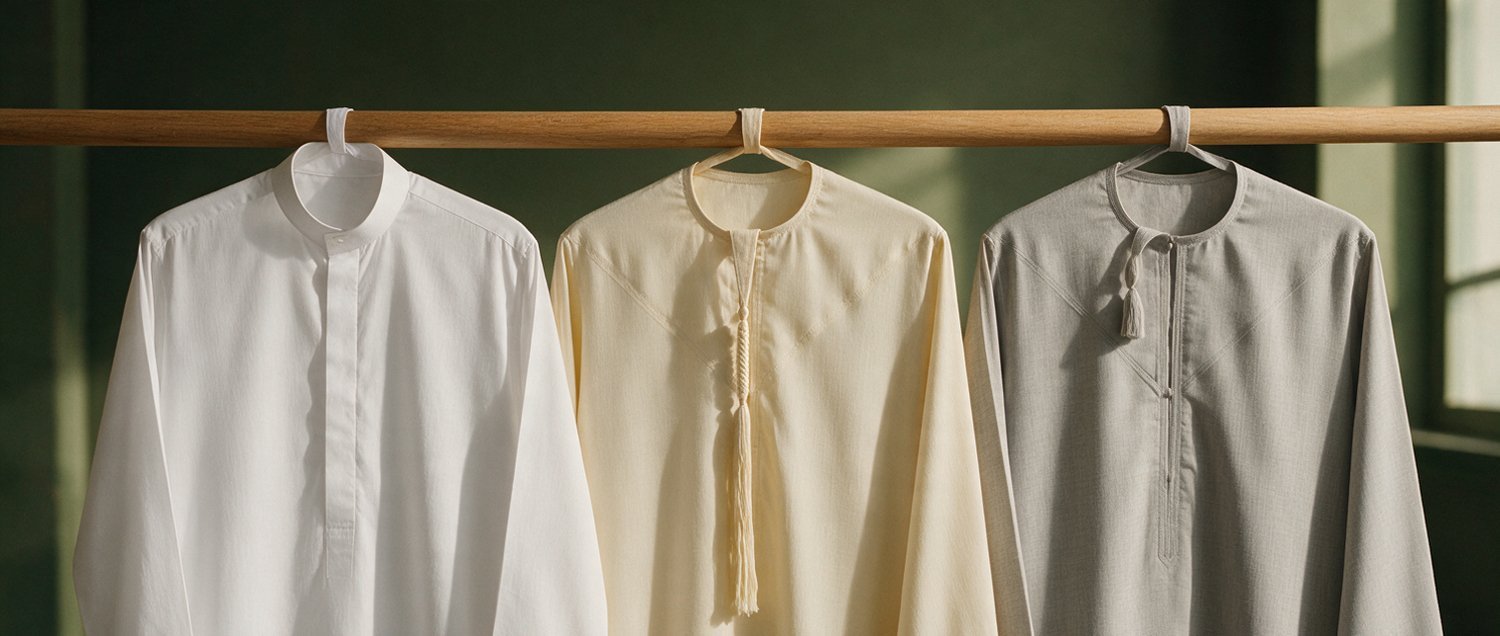
Men follow the same principle of loose, modest clothing, and in the Gulf the everyday answer is the thobe: an ankle-length robe, usually white, with a collar or a collarless neck depending on the country.
It goes by different names — thawb in Saudi Arabia, kandura in the UAE, dishdasha in Oman and Kuwait — and the jubba is a looser tunic-style version worn across South Asia, Africa and Morocco. Many men also wear a kufi or taqiyah cap for prayer. For the regional cuts and how they differ in construction, see our custom thobe manufacturer page.
How to tell them apart in four questions
- Does it cover the face? If yes, it is a niqab (eyes visible) or a burqa (eyes behind mesh).
- Is it only for the head? Wrapped scarf = hijab or shayla. Pull-on = instant hijab or al-amira. Falls straight from the crown over the shoulders = khimar.
- Does it cover the head and the body in one garment? With sleeves and a hood = jilbab. No sleeves, held closed by hand = chador. Made for prayer = prayer dress.
- Is it a robe over clothes that leaves the head to a separate scarf? That is an abaya, closed or open-front.
Visiting a mosque? What non-Muslim women usually wear
This is one of the most common worries from people searching these garment names: they have been invited to a mosque, a wedding or an Eid meal and do not want to get it wrong. The good news is that nobody expects a visitor to own an abaya. What matters is covering, not a specific garment.
- Loose clothes that cover arms and legs. A long-sleeved top with trousers or an ankle-length skirt is enough. One regular on r/islam put it simply: “You should be fine with the jeans and a long sleeved loose sweater.” (r/islam)
- A scarf for your hair inside the prayer hall. Many mosques ask women to cover their hair there; others do not insist for visitors. Bringing any large scarf solves it. “Your hands, face and feet being exposed is ok,” as another answer on r/islam explains.
- Clean socks. Shoes come off at the door of the prayer area.
- Skip slogans and images on clothing, and anything tight or sheer.
Wearing a hijab or an abaya outside a mosque is also generally welcomed when it is done respectfully. On r/Hijabis, a thread on the topic drew this reply: “As an Arab myself, I’ve never met a single Arab who has a problem with non Arabs wearing abayas.” (r/Hijabis) What does cause offence is treating these garments as a costume or a joke.
New to modest dress? Where most reverts start
Women who have recently converted to Islam often feel they need a whole new wardrobe on day one. The advice from women who have been through it is the opposite: start small.
- Start with a prayer hijab. “Get yourself a hijab for prayer for now and familiarise yourself with the basics” is typical advice on r/Hijabis. A simple two-piece prayer set does the same job and goes on over anything.
- One neutral abaya over the clothes you already own. “Get a neutral colored one and wear it over your regular clothes,” as one reply to a revert on a budget put it (r/islam).
- Consider open abayas for everyday. They layer over jeans, dresses and long tops. One convert’s advice was blunt: “Open abayas are a game changer.” (r/muslimgirlswithtaste) See the open abaya styles above.
- Jersey hijabs first, chiffon later. Jersey stays on without pins and survives the washing machine, which makes it easier while you are learning to style one.
If you are building a modest clothing brand
Most of the construction problems in this guide come from one habit: treating these garments as variations of each other. A jilbab made as an abaya with a hood, a khimar cut like a long scarf, an open abaya made by removing the snaps from a closed pattern. Each one looks fine on a hanger and fails when worn. If you are sourcing, ask a factory how they build the specific garment, not whether they “do abayas”.
We see the result when brands bring us jilbabs or khimars made elsewhere and ask us to fix the fit. The same three faults come up again and again: a badly shaped hood that slips back when it is worn, front panels cut out of line so the garment never drapes properly, and fabric so thin it shows through and fails the one job it has. Sometimes the fabric looks good at first glance, and it is the cheap cutting and stitching that make the piece uncomfortable to wear all day or to pray in.
ModestRise makes all of the garments linked above in one factory, from 50 pieces per style and colour, with your own label. You can see the full range on our modest clothing manufacturer page. Retailers buying ready styles in bulk can start with our wholesale abaya supplier page, and brands planning a seasonal drop with our Eid clothing page.
