



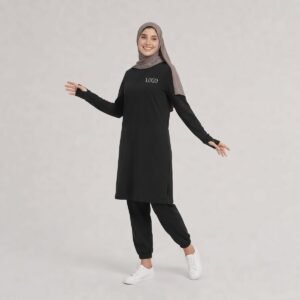








Sports Hijab (Performance Hijab & Under-Cap)
The most reordered item in most modest activewear catalogues, and the hardest to get right. Hijab sportswear fails for one of three reasons — and whether it is a pull-on sports hijab or a two-piece set, the failure modes are the same: slipping during movement, running too hot for long sessions, or pressing hard enough across the forehead to cause headaches.
Construction notes: built as a pull-on one-piece with a wide front band and tapered back, or a two-piece set with a fitted under-cap. The inner band carries the load — a 4 cm silicone-grip tape holds best on smooth hair, while a brushed cotton-jersey band is kinder for yoga. Fabric is cut with the maximum stretch direction running horizontally around the head, so it opens on entry and recovers snug. Opacity is tested at 30% elongation under a daylight panel. 200–240 g/m² polyester/elastane, ≥92% recovery after five cycles, laser-cut front band instead of a folded hem.
Modest Leggings (Full-Length, Squat-Proof, High-Waist)
Modest leggings are worn as the outer layer, which raises the opacity requirement far above a standard gym legging. The difference shows in two places: the seat under a deep squat, and the inner thigh where fabric stretches across the seam.
Construction notes: we test opacity on the finished garment, not on the roll — mannequin in a full squat, lightest colourway, daylight, over a contrasting underlayer. For light greys and pastels we do not go below 240 g/m². The gusset is diamond or three-panel, cotton-lined, which removes the centre seam entirely — a single-seam gusset is the most common cause of seam failure in cheap modest leggings. 240–280 g/m² polyamide/elastane interlock, 20–28% elastane, ≥95% recovery after five cycles. The waistband is a 10–12 cm high-rise panel with an internal power-mesh layer and a silicone gripper strip to stop roll-down. Flatlock 4-needle 6-thread seams at ≥90 N/50 mm, elongation matched to the fabric's own within 10%.
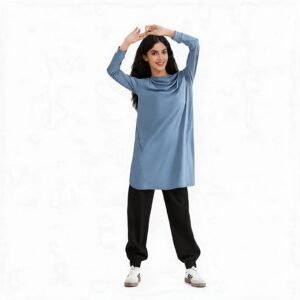
Long-Sleeve Sports Top (Performance Base Layer)
The workhorse of a modest range, and the piece that decides whether your line feels technical or generic. A long-sleeve top has to ventilate far better than a short-sleeve one, because it covers the full arm — the second-largest heat-exchange surface after the back.
Construction notes: breathability is engineered, not added. We place knit-in ventilation zones — a drop-needle eyelet structure or laser-perforated panel — along the spine channel, underarm gusset and inner elbow, where heat accumulates under a full sleeve. The underarm gusset is functional, not cosmetic: it lets the arm raise overhead without the garment hitching up and exposing the waist. Sleeves are set to the wrist bone with a 6–8 cm thumbhole cuff on running styles. 180–220 g/m² polyester/elastane jersey, flatlock seams so there is no ridge under a hijab, wicking ≥100 mm in 30 minutes, anti-odor finish with a 50-wash target, UPF 50+ on outdoor styles.
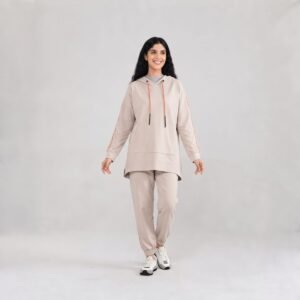
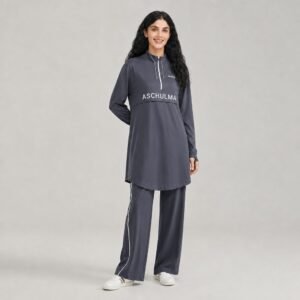
Modest Tracksuit & Jogger Set (Two-Piece)
The highest average order value in the category, because it is bought as a set and reordered as a set. Usually a long-sleeve top paired with a full-length jogger or wide-leg pant — the wide-leg version sells better where the leggings silhouette is less common.
Construction notes: the commercial risk in a two-piece set is shade mismatch, not sewing. Top and pant are cut from the same dye lot in the same run and packed as a set; if a colourway cannot be cut from one lot we tell you before production. Tops are cut slightly longer than a gym hoodie so the hem clears the hip, with a drawcord-free hood on youth ranges for safety compliance. Wide-leg pants take a 26–30 cm leg opening and 72–76 cm inseam on a shaped waist. 260–320 g/m² cotton/elastane French terry or brushed poly/elastane fleece for winter. The jogger waistband is 4–5 cm woven elastic, encased in a self-fabric channel closed with flatlock so no elastic edge touches the skin, and side pockets are bar-tacked at both ends.
Modest Swim & Burkini-Crossover Activewear
The boundary product between this range and our burkini line: long-sleeve rashguard tops, swim leggings and swim tunic sets for water sports, aqua fitness and beach coverage. These are built to a different chemistry, because chlorine and salt water destroy finishes that are durable in a washing machine.
Construction notes: chlorine resistance is what separates a swim piece from a gym piece. Standard elastane degrades in chlorinated water within roughly 30–40 hours of pool exposure; we use chlorine-resistant PBT or a nylon/elastane blend rated to AATCC 162 so the garment holds shape through a season. Seams are flatlock and, on higher-spec pieces, bonded with seam-sealing tape — a swim legging that is only flatlocked will wick water into the seam channel and sag. Rashguard tops take a drop-tail hem, and every piece is tested for opacity when wet — the state that actually matters and the one most suppliers never test. 200–240 g/m², UPF 50+, ≥94% recovery after five cycles. Drawcord-free throughout to avoid entanglement risk.
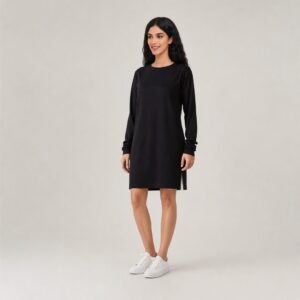
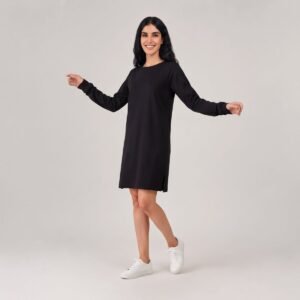
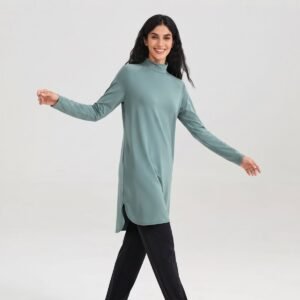
Modest Gym Dress & Long Tunic
A single-piece silhouette that solves coverage in one garment: a long-sleeve top with an integrated skirt hem covering the hip and upper thigh, worn over leggings or on its own for studio work. This is the format most buyers mean when they search for modest gym wear — one garment, full coverage, no separate layering piece.
Construction notes: the engineering problem is movement. A tunic over leggings will ride up during a downward dog or a lunge unless the hem is weighted or the body is cut with enough ease to fall back into place. We solve it with a shaped hem — slightly longer at the back than the front — and a side split of 12–18 cm that lets the leg move without the hem climbing. The internal short under the skirt is attached at the waistband seam rather than worn separately, and cut from the same fabric as the outer so it never shows a colour difference. 220–260 g/m² polyester/elastane, 4-way stretch, ≥93% recovery after five cycles, cut on a relaxed block with 6–10 cm of ease at the hip so the tunic drapes rather than clings. Dress length 82–88 cm; tunic length 72–78 cm.
Wudu-Friendly Activewear (Water-Permeable Construction)
A small but fast-growing niche that almost no general activewear factory can serve. Wudu-friendly garments are built so a wearer can perform ablution without removing them — the fabric at the forearms and lower legs must let water reach the skin in meaningful volume while still working as a performance knit.
Construction notes: the mechanism is an engineered mesh structure, not a coating. We use an open-knit nylon/elastane mesh at the forearm and lower-leg panels with a water permeability target of ≥90%, tested by timed water pass-through rather than a visual check. Critically, the panel is a knit structure — a coating or laminated film would block water entirely, so a supplier offering “water-repellent” fabric here has misunderstood the brief. Mesh is placed only where it is needed; the torso and thigh keep the solid performance knit. 150–190 g/m² warp-knit power mesh at the permeable panels, 200–240 g/m² solid knit elsewhere, both from the same dye lot so panels match. The sleeve takes a non-elasticated cuff so it can be pushed up the forearm without deforming.