





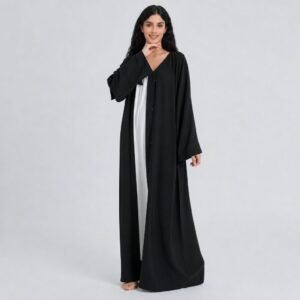
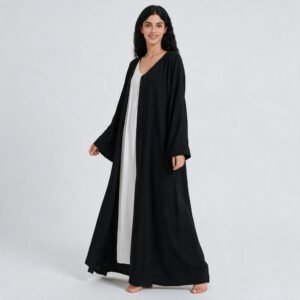




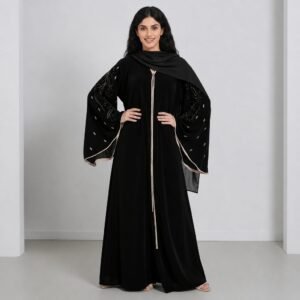

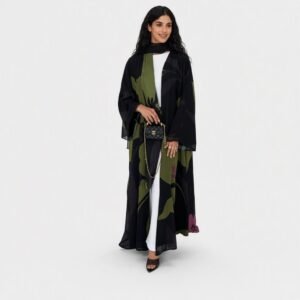

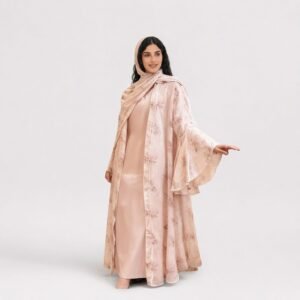

Embroidered Evening Abaya
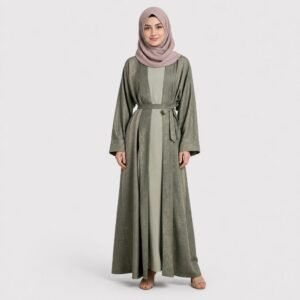
The bridge product between an everyday abaya and a full gown, and the single fastest-moving SKU in most modest evening collections. It keeps the abaya silhouette — front-open or closed, floor length — but adds the surface it needs to read as formal: dense embroidery on the front panel, cuffs and hem, usually with stone or bead application layered over the top. Retail sits $110–260 in the Gulf, £120–280 in the UK, and $140–320 in North America, where a modest evening abaya is often merchandised as an alternative to a cocktail dress rather than as outerwear.
Construction notes: the embroidery is stitched onto a separately cut, stabilised panel before assembly, which means the panel is cut oversized and trimmed back to the pattern line after the hoop comes off. It is the step that costs fabric and the step that cheap factories skip — and it is precisely why embroidery on low-cost evening abayas pulls, puckers and ripples after the first dry clean. On a formal piece we also back the embroidered panel with a soft fusible or a second light layer of organza so the embroidery weight does not drag the front off-grain as the garment hangs. Crystal and stone work is applied after assembly, hand-set for premium pieces, and the entire front placket is lined so no stitch head touches the skin.
Typical fabric: nida, heavy satin, Japanese crepe, jacquard, silk-blend crepe. Fully lined as standard.
Embellished Kaftan & Kaftan-Style Occasion Dress
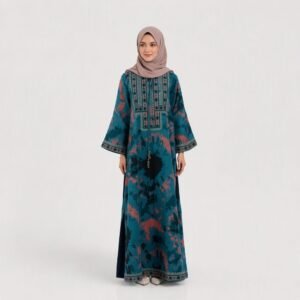
The kaftan is the most forgiving formal silhouette you can sell and the easiest to ship — a relaxed, straight or gently A-line body with a wide sleeve, where all the value sits in the neckline and the cuffs. That is good news commercially: because the garment itself is a simple cut, you can put a genuinely expensive neckline on it and still hit a mid price point. A hand-beaded kaftan at $85–160 FOB retails at $240–480 in Dubai and $300–520 in London, and it photographs better than a structured gown because the fabric moves.
Construction notes: the neckline is the whole product. We cut a faced or bound neckline opening and plan the beadwork as a single continuous composition — a necklace-shaped motif that sits at the collar and down the placket — rather than as a repeated border, because a repeated border reads as budget. Wide sleeves are finished with a deep cuff band (6–10 cm) so the beading has a defined area to sit in and the cuff edge does not flare. On heavier velvet kaftans we underline the front panel to stop the weight of the beadwork pulling the neckline forward and gaping it open.
Typical fabric: silk-blend crepe, chiffon, satin, velvet, jacquard, metallic brocade. Lined in the body, sleeves unlined on velvet.
Modest Maxi Gown (Column / A-Line)
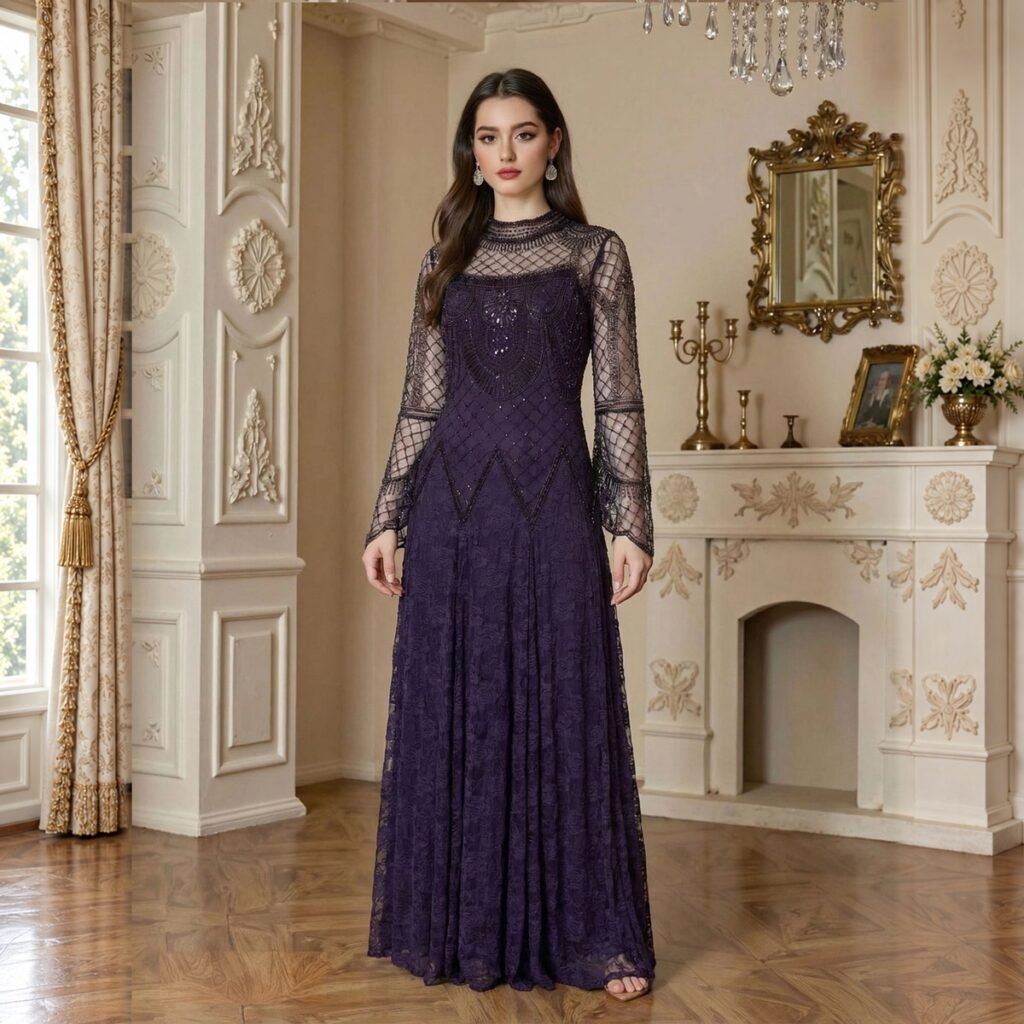
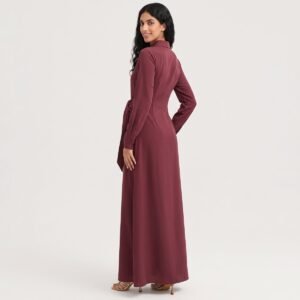
The pure evening product — floor-length, long-sleeved, high or jewel neckline, fully lined, with no layering component and no abaya reference at all. This is what a modest customer buys when a mainstream designer floor-length gown would have required alterations she cannot get, or a sheer back she will not wear. Buyers typically order a gown block as a base and run it in three or four colourways, which spreads the pattern cost across the whole drop.
Construction notes: the main risk on a long gown is the vertical line of the dress going off-grain after it hangs, which shows up as a diagonal pull across the hip or a hem that twists to one side. We cut every gown panel on the table with the fabric relaxed for 24 hours first, cut the centre-back and centre-front on a true straight grain rather than folded, and hang the assembled gown for 24–48 hours before the hem is marked and levelled. A gown hem marked on the table and never hung will sit uneven on a real body. Column gowns get a walking vent or a concealed back split at the hem so the wearer can actually walk, and A-line gowns are cut with panel gussets rather than gathered flare so the hem keeps its line.
Typical fabric: satin, satin-back crepe, taffeta, mikado, heavy chiffon over lining, silk blend. Fully lined, always.
Two-Piece Formal Set
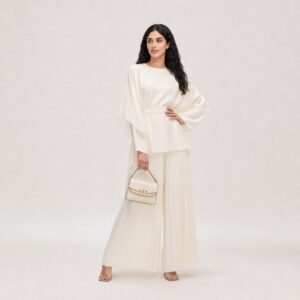
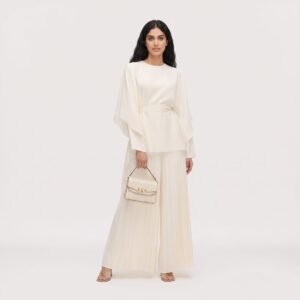
A long skirt or wide-leg trouser with a matching top — tunic, blouse, cape or jacket. It is the highest-value form of modest evening wear per unit of construction because the customer is buying two garments but the factory is doing one colour lot, one lining run and one embellishment plan. It also has the best fit tolerance of anything in this range: a skirt waistband plus a top with an easy body forgives the fit problems that a fitted column gown punishes. Brands that cannot sell a $300 gown can usually sell a $260 two-piece set to the same customer.
Construction notes: the two pieces must match in shade, which means both must be cut from the same dye lot and ideally from the same roll. Skirt waistbands sit on a fixed waistband with a concealed side or back zip and an internal hook-and-bar, not a drawstring. Where the top is embellished we bead the top first and then confirm the fabric allocation for the skirt, because embroidery and beading can consume 15–20% more meterage than a plain panel. Trousers are cut wide-leg with a lined waistband so the pocket bags never print through a light fabric.
Typical fabric: crepe, satin-back crepe, heavy chiffon with lining, jacquard, velvet. Both pieces fully lined.
Eid & Party Dress
The seasonal volume product. Eid runs twice a year on a hard calendar date, and a party dress order is the one line where a brand can justify a louder surface — dense sequin, allover stone, metallic thread embroidery, sheer sleeves over a solid lining. Price points cluster at $60–140 retail for a mid-market Eid dress and $180–420 for a party piece from a designer label. Order volume is high but the window is fixed, which is where most buyers get caught.
Construction notes: sequin and metallic-thread fabrics are unforgiving in two specific ways. First, they are slippery and shift under the needle, so every seam needs a stabilising tape or a fine fusible along the seam line and a size 70/10 needle with a light thread tension — a heavy needle punches holes that never close. Second, the cut edge sheds, so the whole garment must be lined and the seam allowances overlocked or bound, or the interior fills with sequins and the wearer itches. We cut sequin and beaded fabrics with the nap direction marked on every panel, because a piece cut the wrong way reads as a different colour under stage lighting. Any piece with sequin at a sleeve or neck edge gets a soft backing strip so no cut sequin edge contacts the skin.
Typical fabric: sequin mesh, metallic jacquard, embroidered tulle over satin, satin, velvet. Fully lined with a soft-touch lining.
Mother-of-the-Bride / Mother-of-the-Groom Style
An underserved, price-insensitive, high-expectation buyer. She is not shopping for herself on a budget — she is shopping for a photograph that will be framed and looked at for thirty years, and she will pay for it. The silhouette almost always includes a structured third layer: a long coat, a cape, a jacket with a shaped shoulder, or a removable overlay. That layer is why this product carries the highest unit value in the range and also the highest number of fit adjustments.
Construction notes: the third layer is a separate garment and must be patterned as one — cape and coat overlays get their own lining, their own hem level, and their own hanger loop. Coat overlays are the one place in this range where we routinely use a shaped shoulder pad, because a soft shoulder collapses under the weight of a beaded overlay and the whole silhouette goes slack in photographs. Neckline height is the sensitivity on this product: the buyer expects full coverage at the chest and a neckline that stays put when she leans forward, so we build the neckline with a hidden stay tape across the front and, where the fabric is heavy, an internal grosgrain stability strip. The wearer is often between two ready sizes, so we offer made-to-measure grading on this product as standard rather than as an extra.
Typical fabric: mikado, jacquard, taffeta, wool-blend suiting, velvet, silk shantung. Coat and dress fully lined; lining is a matte crepe-polyester with a dry-clean-safe finish.
Modest Bridesmaid Dress (Colour-Matched Sets)
A bridal-party order is not a bulk order — it is a set of graded garments that must look identical in daylight. Every bride has seen a bridesmaid photograph where one dress is a shade off, and that is the single complaint this product is judged on. We treat it as a continuous-lot production job: one dye lot for the whole party, panels cut sequentially, and every garment checked side-by-side against the others before packing rather than individually against a shade card.
Construction notes: bridesmaid sets are normally ordered in four to six sizes across one or two colourways, so the grading has to be built from a single block and then checked on each size. Shawls, capes and covers are cut from the same lot as the dresses — a cover in a slightly different lot is the most common failure on this product. Where the bridal party is split across two delivery dates, we hold the balance fabric on the same lot and confirm the hold in writing, so a later addition can still be matched. Heavier coverage requirements (long sleeve, high neck, opaque) are standard on this block, not modifications.
Typical fabric: heavy chiffon over satin lining, crepe, satin, tulle with a solid underlay, jersey crepe for drape. Fully lined.