

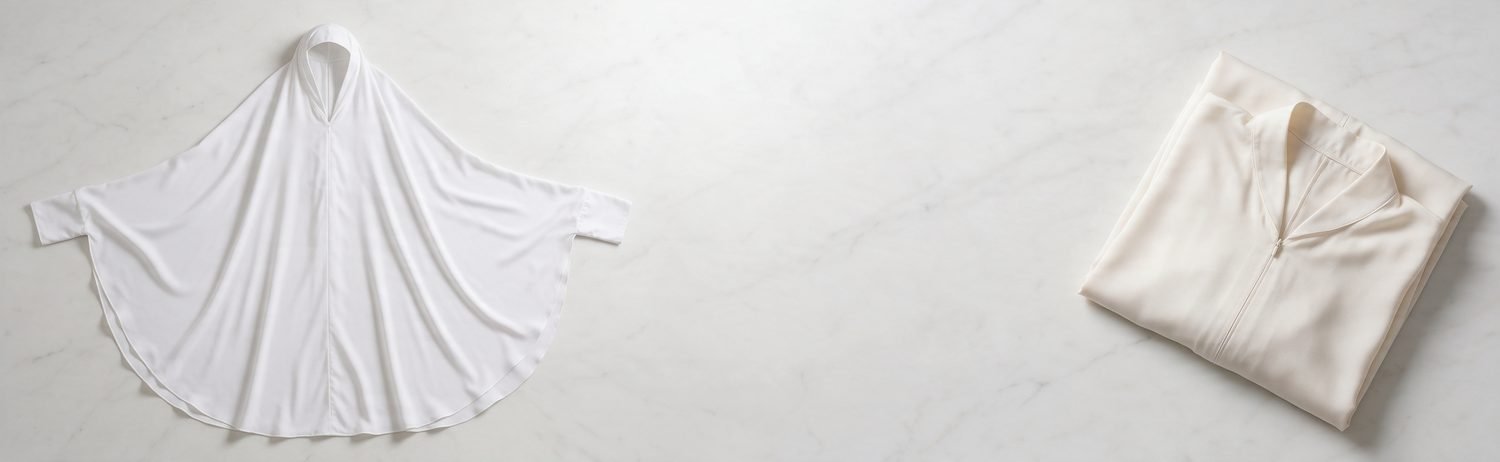








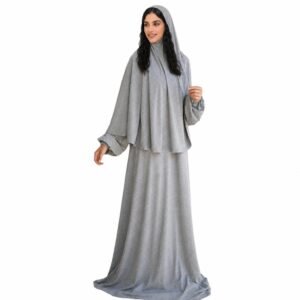
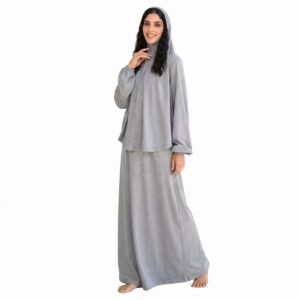
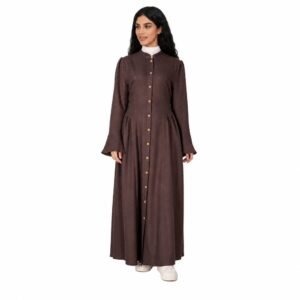

Two-Piece Prayer Set (Khimar + Skirt)
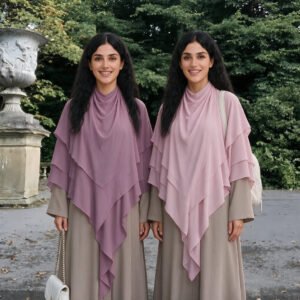
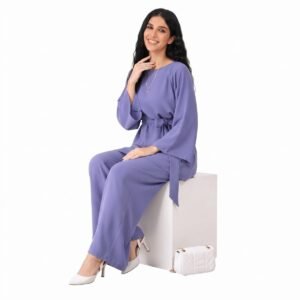
The best-selling construction in the category, and the one we recommend to almost every buyer as their first SKU. Two pieces: a pull-on khimar that covers the head, neck, ears and chest, and an elasticated skirt. Packed, folded and bagged together as one retail unit with a single barcode.
Why two-piece outsells one-piece. This is worth understanding before you place a purchase order, because it is counter-intuitive to buyers who assume a one-piece is simpler and therefore easier to sell. It is not. A two-piece set lets the customer put the khimar on first, adjust it in front of a mirror, and then step into the skirt — which means the khimar can be positioned correctly without the wearer having to pull a full-length garment over an already-fixed headpiece. During wudu, the skirt stays on and only the khimar is lifted. During sujud, the skirt hem is not connected to the headpiece, so a knee bend does not drag the khimar forward off the forehead. And commercially, the two pieces can be sized independently, which means one set fits a much wider band of body types than a single graded garment — a real advantage when you are selling online and cannot offer fittings.
Construction notes: the khimar is cut as a single piece from the crown down, with a shaped face opening — not a tube — so the fabric falls away from the face rather than resting on it. The khimar length runs 90–110 cm from crown to back hem as standard; shorter if you are selling into a market that layers it under an abaya, longer into markets where the khimar is worn alone and needs to cover to the thigh in sujud. The skirt is a pull-on with a 4 cm elasticated waistband, casing-stitched so the elastic cannot roll, and the waistband is cut to 1.8–2.2× the flat body measurement so the skirt clears the hips and the knees without lifting the hem during prostration. Skirt length 95–105 cm, and we grade in 5 cm increments.
Typical fabric: poly-cotton poplin, cotton jersey, viscose, polyester crepe, crinkle rayon.
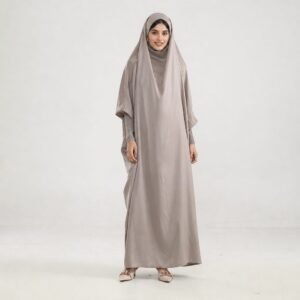
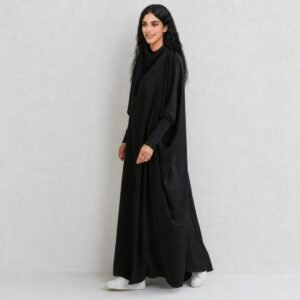
One-Piece Prayer Dress
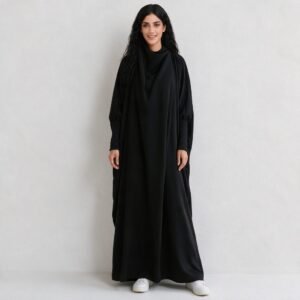
A single full-length gown with the headpiece integrated at the shoulder line, or attached at the neck seam. Preferred in Gulf markets, in parts of North Africa, and by older customers who find a separate khimar fiddly. Also the stronger construction for a gift SKU, because it presents better flat in a box.
Construction notes: the headpiece is joined at the neckline seam rather than worn over the shoulders as a separate layer, so the seam has to be positioned to sit behind the hairline when the garment is on — too far forward and it irritates the forehead during sujud, too far back and the fabric gapes at the collarbone. We set this from a wear test, not from a measurement table. Because the front and back panels are effectively a single continuous fall of fabric, the one-piece is cut from a single ply where panel width allows, which avoids the shade line that appears when two panels are joined from different parts of the roll. The face opening is finished with a narrow folded binding rather than a raw hem — a raw hem on a face opening frays within a few washes and is the most common complaint on cheap one-piece prayer gowns.
Typical fabric: poly-cotton, viscose, crinkle rayon, cotton voile, jersey knit.
Prayer Khimar With Ties
A khimar sold as a standalone piece, with a fixed fastening rather than a plain pull-on crown. Ordered by customers who already own skirts or abayas and want the head covering on its own, and increasingly bought as a two-colour pack so the customer can mix the khimar with a skirt she already has.
Construction notes: the fastening is the whole product, and there are three routes. Ties — two fabric tapes, 45–60 cm long, sewn into the side seams at ear level, knotted at the back of the head; longest to put on correctly but the most secure and the most adjustable. Snap — a single hidden snap or two-snap placket under the chin, fastest to fasten, but the fit is fixed and the snap must be corrosion-resistant because it lives against the skin and near moisture. Elasticated band — a 3 cm covered elastic headband at the crown, no fastening at all; the easiest to put on and the most popular for kids and for older customers, but it needs a correctly tensioned elastic or it slides back off the hairline. We tool for all three and will send you samples of each. Ties must be flat-felled, not just folded and stitched, or the knot will not hold and the tape will curl after the first wash. Snap placement is set from a wear test so the khimar does not gap at the jaw when the head turns.
Typical fabric: crinkle rayon, viscose, cotton jersey, chiffon (lined), moss crepe.
Travel Prayer Garment — Hajj & Umrah
A lightweight, fast-folding set built to live in a handbag or a carry-on. Ordered in high volume by Hajj and Umrah travel retailers, airport gift shops, and tour operators who buy them as customer gifts. The design brief is narrow and specific: pack small, weigh little, dry fast, do not crease, and go on in under thirty seconds in a space the size of a phone booth.
Construction notes: 90–120 g/m² fabric, garment weight held under 350 g for the full set. The set folds into its own integrated pocket or into a separate matching pouch with a drawstring or zip closure, sized 22 × 16 cm flat — small enough for a handbag, large enough that the customer is not fighting the fabric back in. Seams are overlocked and flat so there is nothing to press. Elasticated waist on the skirt rather than a tie, because a tie needs two hands and a mirror. No metal hardware anywhere on the garment except a single low-profile snap, so nothing sets off an airport scanner and nothing rusts in a humid climate. A note on ihram: women in ihram must not cover the face or the hands, so we deliberately do not build the face-covering or hand-covering into the travel garment — the khimar is a separate piece the wearer can lift. If your market expects an attached face panel, tell us, and we will cut it so it can be worn back and lifted independently.
Typical fabric: crinkle rayon, cotton voile, jersey knit, 100% polyester micro-crepe, bamboo blend.
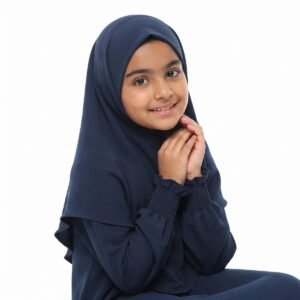
Kids Prayer Set
Sizes 4–14, same two-piece construction scaled down, sold on its own and increasingly in mother-and-daughter matched pairs, which is one of the strongest gift mechanics in this category. High-gift, high-repeat, and heavily seasonal around Ramadan and Eid.
Construction notes: kids' prayer sets are a safety product, not just a scaled-down adult product, and the construction has to reflect that. No drawcord at the neck or waist on any size — a cord around a child's neck is a strangulation hazard and will fail testing in the US and EU. No small beads, sequins, rhinestones or loose appliqué parts below a defined size threshold; if your design calls for decoration, we use embroidery or printed detail instead, because embroidery is stitched into the fabric and cannot detach. Ties, where used, are cut short — under 22 cm — and flat-felled so they cannot form a loop. The elasticated waist runs at a lower tension than the adult specification so it does not mark the skin, and the hem is finished 2 cm shorter than an adult ratio so a child does not step on the front of the skirt during sujud. All kids' styles can be produced to EN 71-3 and CPSIA test standards with third-party lab reports on request.
Typical fabric: cotton jersey, poly-cotton, single jersey knit, printed cotton (rotary or digital), soft viscose.
Prayer Mat + Garment Set
A bundled SKU: a prayer garment plus a folding prayer mat, packed together in one box or one carry bag. The strongest gift-box product we make, and the one that gets the highest average order value, because it reads as a complete gift rather than a single item. Bought by gift retailers, mosque shops, corporate gift buyers and travel operators.
Construction notes: the mat needs to fold or roll to a size that fits the same pouch as the garment — we standardise the pouch around the folded mat, not the other way round, because an undersized pouch kills the product. Mats are built with a brushed polyester face, a 3–5 mm foam or felt core, and a non-slip backing; edges are bound with a woven tape rather than overlocked, because an overlocked mat edge curls and frays at the corners after a few folds. If your mat carries a compass, a qibla marker or a printed dua card, that is a print job, not a sewing job, and needs to be ordered at the same time as the fabric so the two arrive together. Sets can also include a tasbih and a printed card — we pack all components as one retail unit with a single barcode.
Typical fabric: polyester micro-crepe (garment), brushed polyester with foam core (mat), 210D polyester (pouch).
Eid Special Prayer Dress
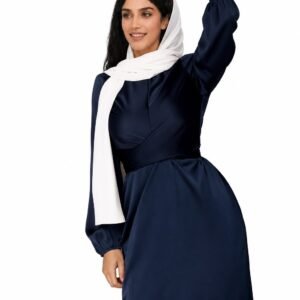
The dressed-up end of the range. Satin, chiffon, embroidered and lace-trimmed prayer dresses with matching khimar, built for Eid al-Fitr and Eid al-Adha and for the Ramadan peak, when customers buy a prayer garment as a gift rather than for utility. The highest-margin SKU in this category, and the one with the hardest calendar date attached to it.
Construction notes: the construction problem with an Eid prayer dress is that it has to look festive without becoming impractical for salah. Satin and chiffon are slippery, so a glossier khimar will slide back off the hairline unless the crown has a hidden grip band — we build one in, usually a strip of cotton jersey or a silicone-dotted tape, and it is the difference between a garment that stays on and one that gets returned. Embellishment is applied to a stabilised panel before assembly, then the panel is trimmed — this is the step that stops embroidery puckering after the first wash, and it is the step cheap factories skip. Beadwork and crystal on a prayer garment must be hand-set or heat-set flat to the fabric, never raised on a stalk, because the wearer's forehead contacts the floor during sujud and a raised stone is uncomfortable and detaches. Book Eid and Ramadan capacity 8–10 weeks ahead; hand embellishment is a limited resource across the whole industry, not just this factory.
Typical fabric: satin, chiffon (lined), Japanese crepe, moss crepe, embroidered tulle over solid ground.