50 pcs

Minimum order per style and colour

50+ styles

Ready to customise or develop

8–12hr Reply

We reply to every inquiry within 8–12 hours

From $14.95

FOB factory price per piece

7–10 days

Sample lead time

30–45 days

Bulk production after sample approval

OEKO-TEX® & GRS

Certified swim fabrics on request

DDP Worldwide

Door-to-door with duties included

OEKO-TEX® Standard 100 GRS 4.0 Recycled BSCI ISO 9001 UPF 50+ tested to AS/NZS 4399

Chlorine-resistance, colourfastness and UPF test reports available on request.

Burkinis & Modest Swimwear We Manufacture

What Buyers Actually Order When They Source Burkinis

A burkini is not a swimsuit with more fabric. It is a garment engineered for two conflicting requirements at the same time: it has to cover completely and stay opaque when wet, and it has to move, stretch and drain like performance swimwear. A 3-piece set for a resort shop in Dubai, a chlorine-resistant training burkini for a swim school in Kuala Lumpur and a printed kids' set for a European online retailer look similar on a product page and are three completely different builds — different fabric base, different elastane content, different seam type, different testing.

That is why we organise production by style family and end use rather than by a single catalogue number. It lets you mix a high-margin recycled ECONYL® line with a volume polyester–spandex line in one order, share the same size grading across both, consolidate into a single carton and book one shipment. The garment is also ordered as burkini, burqini, modest swimwear, full-cover swimsuit, Islamic swimsuit or muslim swimwear depending on the market — the construction logic is the same, only the search language changes. We manufacture for brands across Southeast Asia, the Middle East, Europe, North America and Australia — from wholesale burkini programmes for chain retailers to OEM boutique lines. We ship DDP door to door. Commercial support in English, Arabic and Malay.

Three specs decide whether a burkini order becomes a reorder or a return: opacity when wet, elastic recovery, and seam integrity under chlorine. Everything below is built around how those three behave in the water, not how the garment photographs on a hanger.

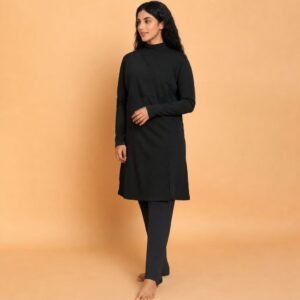
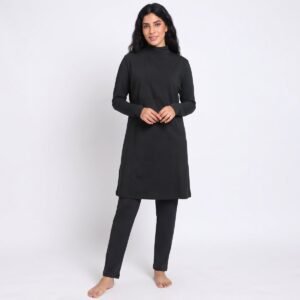
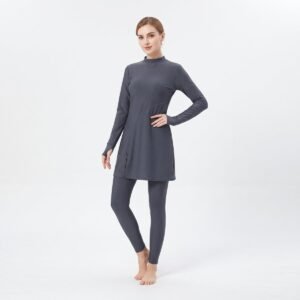
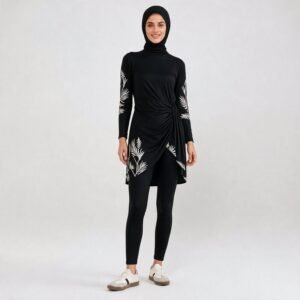
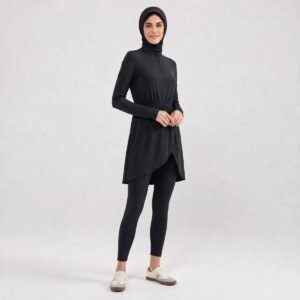
Full-Cover 3-Piece Burkini Set (Hood, Tunic & Pants)

The volume product in most markets and the style that carries a whole burkini range. Three separate pieces — a fitted swim hood or cap, a long-sleeve tunic that reaches mid-thigh, and full-length pants — sold as a set or split into individual SKUs. Because the three pieces are cut from the same dye lot in the same order, the match between hood, tunic and pants is the first thing a customer checks on delivery.

Construction notes: tunic body cut as a single front and single back panel to avoid a wet shade line down the centre. Sleeve and pants hem finished with a narrow cover-stitch or flatlock, never a folded hem — a folded hem on swim knit wicks water and stays heavy. Pants have an elasticated self-fabric waistband rather than exposed elastic, and ankle cuffs are fitted with a soft elastic so the leg does not balloon in water. Hood is cut on the cross-grain for stretch direction across the head. All seams are 4-needle 6-thread flatlock so the seam sits flat on the skin and does not chafe under a wetsuit or rash vest.

Typical fabric: 80% polyester / 20% spandex, 190–220 g/m², UPF 50+, with a matching opaque tunic lining at 150 g/m² power mesh or self-fabric.

Two-Piece Burkini (Swim Hood + One-Piece Body)

The streamlined, athletic option. A separate hood plus a one-piece body suit with long sleeves and full-length legs. Two pieces instead of three means less bulk, faster drying and fewer places for water to weigh a garment down — which is why this is the shape competitive and recreational swimmers choose. It is also the easiest burkini to merchandise online because it photographs as one clean silhouette.

Construction notes: body suit cut as a one-piece with a centre-front and centre-back seam for stretch control, or as a 4-panel torso where the print requires panel-matching. Gusset is double-layered and flatlocked — this is a non-negotiable on any one-piece swim garment and is where cheap burkinis fail first. Neckline sits close to the collarbone with a narrow self-fabric binding that stays put when wet. Inseam runs 26–29 inches as standard; we grade to your market.

Typical fabric: 78% nylon / 22% spandex for a softer hand and better recovery, or chlorinated-water PBT for training use.

Zip-Front & Zip-Side Burkini

Preferred by resort, hotel and spa buyers, and by any market where the customer is changing poolside rather than in a cabin. A zip changes how the garment goes on and off, and it is the single feature most requested by buyers serving older customers or customers with limited shoulder mobility.

Construction notes: the critical detail here is the zip itself. A standard metal or moulded nylon zip corrodes and stiffens in chlorinated and salt water within a season — we specify a chlorine-resistant nylon coil zip with a plastic or coated puller on all swim garments, and we test it through 40 wet-dry cycles before approving the spec. The zip tape is stabilised with a knitted tape and the surrounding seam is flatlocked, not overlocked, so the zip does not pucker when the garment stretches. On front-zip styles we add an internal zip guard so the puller does not contact skin when the suit is wet, and a lock-down tab at the top of the zip. On side-zip styles the zip is placed on a princess seam line so the seam is doing the work.

Typical fabric: 80% polyester / 20% spandex, 200–230 g/m², or Italian swim knit for premium resort lines.

Sport & Chlorine-Resistant Burkini

This is the build for swim schools, triathlon-modest ranges, aqua-fitness, and anyone in the pool three or more times a week. What separates it from a fashion burkini is the fibre, not the styling — and it shows up after a season, not on the hanger. Standard elastane breaks down in chlorinated water, which is what leaves ordinary swimwear baggy at the knees and seat. Sport burkinis run on PBT polyester or chlorine-resistant elastane, and hold their shape across hundreds of pool hours.

Construction notes: PBT polyester or Xtra Life LYCRA® blend at 180–210 g/m² with 18–22% elastane for genuine four-way stretch. All thread is polyester, never cotton — cotton thread rots in chlorine and takes the seam with it. Seams are 4-needle 6-thread flatlock throughout, with bar-tacks at every stress point (armhole, crotch, waistband join, zip end). We add a power-mesh bra shelf or a sewn-in soft cup where the buyer wants support without a separate bra. Thumbholes and extended sun sleeves available for open-water and surf ranges. Chlorine-resistance tested to AATCC 162 and stretch-recovery tested to a minimum 85% recovery after 5 cycles.

Typical fabric: PBT polyester–spandex, 180–210 g/m², chlorine resistant; or Xtra Life LYCRA® blend for a softer hand at the same durability.

Swim Hijab, Khimar & Separate Swim Turban

Sold three ways: as part of a set, as a stand-alone accessory SKU, and as a replacement piece. A swim hijab is the hardest single item in the range to get right because it has to stay in place in moving water, drain fast, and not pull at the hairline or ears. Buyers who get this piece right sell it as an repeat-purchase accessory; buyers who get it wrong get it returned.

Construction notes: cut from the same four-way stretch swim knit as the body, with an elongation factor matched to the body fabric so the hood and the suit age at the same rate. The inner edge is a narrow self-fabric band rather than a bulky elastic casing, so it grips without leaving a mark. Cross-grain cutting across the crown gives lateral stretch over the head. Khimar-length swim hijabs (shoulder or chest length) need a slightly heavier fabric — 210–230 g/m² — or the back panel floats up in water. Swim turbans for under-cap use are cut tighter and often lined with a lightweight mesh for drainage. We test every hood design by submerging a mannequin head and checking for displacement and cling before bulk.

Typical fabric: 80% polyester / 20% spandex, 190–230 g/m², colour-matched to the body of the set.

Kids & Teen Burkini (Ages 4–14)

Kids is a fast-growing part of this category in Europe, Southeast Asia and the Gulf, and it does not behave like adult swimwear. Parents buy on coverage and sun protection first, and a child grows out of the garment long before wearing it out. That combination punishes anyone who treats kids as a scaled-down adult, and it puts the sizing curve at the centre of the order.

Construction notes: graded in a dedicated children's block rather than scaled from the adult pattern — the torso-to-leg proportion is different and a scaled adult pattern rides up at the shoulder. Sizes 4–14 years in two-year bands. Higher elastane content (20–24%) for easier dressing. Chin-strap or tie-back hood options so the hood stays on a moving child without pinching. Neck opening has a wide soft binding, no exposed elastic. UPF 50+ is tested on the finished fabric, not assumed from the fibre. Prints run through sublimation so the pattern does not crack when the fabric stretches, and all trims are pull-tested to the applicable children's safety requirement for the destination market.

Typical fabric: 82% recycled polyester / 18% spandex, 190–210 g/m², or standard polyester–spandex for volume price points.

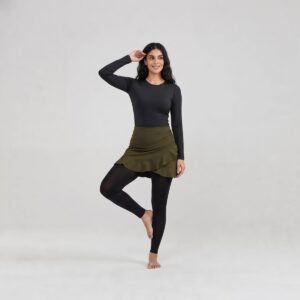
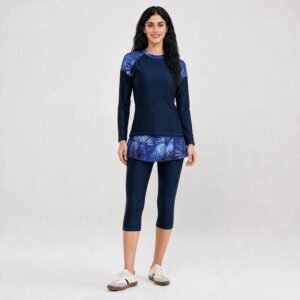
Modest Swim Dress & Swim Leggings Sets

This is the shape for buyers whose customer is not a swimmer at all — she is at the beach, at a spa, or at a water park with her children. A swim dress is a one-piece with a skirted hem over an integrated brief or legging. You get the coverage without the assembly of a three-piece, and it flatters a wider age range than a fitted burkini. Swim leggings sell on their own, or as a co-ord with a swim tunic or rash top.

Construction notes: the dress shell needs a light fabric (170–190 g/m²) or the skirt becomes heavy in water and drags the bodice down — the skirt is attached at a waist seam with a cover-stitched join rather than a gathered join, which would trap water. Integrated briefs are double-layered and flatlocked. Swim leggings are cut with a contoured waistband and a gusset panel; the knee area is where bagging shows first, so leggings use the highest-recovery fabric in the range. Skirt lengths run 34–40 inches total garment length as standard.

Typical fabric: 80% polyester / 20% spandex, 170–200 g/m², with a lighter power-mesh skirt lining.

Swim Fabric Guide — What Each Fabric Actually Does In Water

Swim fabric drives most of a burkini’s cost, all of its durability, and the complaint you will hear most often — going see-through in the water. These are the knit bases we hold and run regularly. Need something outside the list? We source against your specification.

Fabric Weight Properties in water Best for Price tier
Polyester–Spandex 80/20190–220 g/m²Quick-dry, UPF 50+, holds colour, moderate chlorine resistanceVolume burkini sets, printed ranges, kidsEntry
Nylon–Spandex 78/22190–220 g/m²Softest hand, best recovery, lower chlorine resistance than PBTPremium fashion burkinis, 2-piece athletic cutsMid
PBT Polyester180–210 g/m²Chlorine resistant, high shape retention, firm compression feelTraining burkinis, swim schools, aqua fitnessMid
Xtra Life LYCRA® blend190–230 g/m²Chlorine-resistant elastane, softer than PBT, up to 10× lifespan of standard elastanePremium sport burkinis, resort rangesPremium
Recycled Polyester (REPREVE)190–220 g/m²Same performance as virgin polyester, GRS certified, rPET content 75–100%Sustainability-led brands, EU and AU marketsMid
ECONYL® regenerated nylon190–230 g/m²Regenerated from ghost nets and nylon waste, premium hand, excellent recoveryPremium eco collections, flagship SKUsPremium+
Italian swim knit (Carvico / Eurojersey)190–240 g/m²Dense, fully opaque, superb recovery, made in Italy with mill certificationLuxury and boutique burkini linesPremium+
Ribbed swim knit210–260 g/m²Textured surface, more opaque per gram, slower dryFashion-forward resort and co-ord setsMid–Premium
Power mesh (lining)140–170 g/m²Opaque, high compression, used as a second layer, fast drainingTunic and dress lining, bust support panelsEntry (as lining)
Printed swim knit (sublimation)190–230 g/m²Print bonded into the fibre, will not crack or peel with stretch; requires white or light baseKids ranges, tropical and geometric printsMid

Will it go see-through when wet? This is the question that decides a reorder, and it cannot be answered from a weight number or a swatch held up to a window. A 200 g/m² white swim knit is translucent in water; the same knit in navy is fully opaque. White, ivory, blush, mint and pale grey swim fabrics require an opaque lining layer in the tunic and the pants, and we build that into the specification and the price before you commit — not after the first customer complaint. We test opacity on the assembled garment, wet, in daylight, against a black reference, before bulk cutting.

What about stretch recovery? Swim knit has to return to shape after being stretched by movement and loaded with water. We specify a minimum 85% recovery after 5 stretch cycles and test every bulk lot. Low-recovery fabric is what makes a burkini bag out at the knee and the seat after a season — the garment still fits at the shoulder and looks exhausted everywhere else.

Coverage, Opacity and UPF — The Three Specs That Decide a Reorder

Three technical specifications account for most burkini returns and most of the difference between a $15 garment and a $30 garment. None of them are visible on a product photograph, and all three are cheaper to fix at our burkini factory before production than after.

1 — Coverage and opacity. You cannot buy coverage from a fabric spec sheet. Four things have to line up: how opaque that particular colour is, how the garment is cut at the neck, wrist and ankle, whether the cloth clings or floats in water, and whether the hood stays put. A pale colour in a lightweight knit will cling and read through at the bust and thigh however long the sleeves are. Our standing fix is a matched opaque lining in the tunic body and pants front, and a 190 g/m² minimum weight for any pale colourway.

2 — UPF. A UPF number is only as good as the state the fabric was in when it was tested. Density, colour depth, stretch and any UV-blocking finish all move the result; the fibre name on its own tells you nothing. A knit that tests UPF 50+ lying flat can drop measurably once it is pulled over a body — which is how it gets worn. So we test stretched swatches to AATCC 183 or AS/NZS 4399, not flat ones. Dark and dense protects; pale and stretched protects least. Selling into Australia, the Gulf or Southeast Asia with a sun-protection claim? Put UPF on the tech pack and we ship the report with the goods.

3 — Chlorine and salt resistance. Chlorine eats the elastane and leaves the base fibre alone. That is why a swimsuit goes slack at the knee while the colour still looks new. PBT and chlorine-resistant elastane blends hold their shape across hundreds of pool hours; standard elastane gives up inside a season. If your customer is in the water more than once a week, moving off standard spandex to a chlorine-resistant base is the one spec change worth the money.

What You Can Customise on a Burkini

Coverage Level
Full-coverage 3-piece, 2-piece athletic, swim dress with skirted hem, swim leggings, or a tunic-and-legging co-ord. Sleeve length, leg length and tunic drop are all graded to your market.
Sleeve Type
Long set-in sleeve, raglan, extended sun sleeve with thumbhole, fitted cuff, or short sleeve for warmer markets. Raglan gives the best range of motion in water.
Leg & Pant Style
Full-length fitted pants with ankle elastic, straight-leg pants, capri, leggings with contoured waistband, or an integrated brief under a skirt. Ankle fit is what stops the leg ballooning.
Hood & Head Cover
Fitted swim cap hood, fuller khimar-length hood, turban-style under-cap, chin-strap or tie-back closure, or a separate swim hijab sold as its own SKU.
Lining
Unlined dark colourways, or a matched opaque lining in tunic, pants front and skirt. Pale and white colourways are always lined — we will not cut them unlined.
Cups & Support
Power-mesh bra shelf, removable foam pads in a mesh pocket, sewn-in soft cups, or fully unlined. Removable pads are the most-requested option from online retailers.
Colour & Print
Solid dye to Pantone, or sublimation print to your artwork. Lab dip in 5–7 days. Pale and pastel shades need more matching rounds than dark shades and a lining layer — allow for both in your calendar.
Branding & Packaging
Woven neck label, care and composition label, hangtag, printed polybag, swim-mesh pouch, tissue wrap and gift box — all under your brand, none carrying ours.

OEM vs ODM vs Private Label for Swimwear

OEM, ODM and private label get used interchangeably, and that confusion costs buyers real time and money. They are three different commercial arrangements, with different minimums, different development times, and very different amounts of control over what is actually yours at the end.

  OEM — Your Design ODM — Customise Ours Private Label
Who designs itYouWe hold the base block, you modifyEither — label only
What you supplyTech pack, measurements, fabric and trim specReference garment or style selectionLogo artwork
Minimum50 pcs per style and colour50 pcs per style and colour50 pcs per style and colour
Development time2–4 weeks (pattern, block and proto)7–10 days (modify existing block)None — label artwork only
Who owns the designYou, exclusivelyYou own your version; base stays oursBase is shared; label is yours
Best whenYou have a fit, cut or print that is genuinely yours and worth protectingYou want speed to market at low development riskYou are testing demand in a new market before investing in design

An honest note on private label: it is the fastest and cheapest way to launch a burkini line, and it is also the most fragile position to hold. If your burkini is a stock base with your label sewn in, another retailer can buy the same base next season and undercut you on price — the customer has no reason to stay. That is acceptable for a first test order. It is not a business. Brands that survive their second season almost always move to ODM and then to OEM, because that is the point at which the product stops being interchangeable with everyone else's.

Size Chart — Burkini & Modest Swimwear Grading

Modest swimwear is sized on standard dress sizing in most markets, with Gulf and Southeast Asian buyers often preferring a looser body fit and European buyers a closer one. We grade to whichever curve your market uses and we can hold two curves — one for EU/UK, one for Gulf — on the same production run. Custom grading to your own size chart is included at no extra cost.

Size Bust (cm) Waist (cm) Hip (cm) Tunic length (cm) UK / US equivalent
XS80–8462–6686–9078UK 6 / US 2
S85–8967–7191–9580UK 8 / US 4
M90–9572–7796–10182UK 10–12 / US 6–8
L96–10278–84102–10884UK 14 / US 10
XL103–11085–92109–11686UK 16–18 / US 12–14
2XL111–11993–101117–12588UK 20–22 / US 16–18
3XL120–129102–111126–13590UK 24–26 / US 20–22

Kids sizing runs 4–14 years in two-year bands, graded on a dedicated children's block rather than scaled from the adult pattern. Tolerance ±1 cm on all measurements. Extended sizing to 4XL and 5XL is available on request — the pattern work is included, only the fabric cost changes.

Burkini Pricing: MOQ and Lead Times by Tier

Indicative burkini wholesale pricing, FOB China. Final pricing is confirmed from your specification — fabric base, elastane content, lining, cups and print coverage move the number more than volume does. All prices are per piece, per style, and include your woven label, care label and individual polybag.

Style 50–199 pcs 200–499 pcs 500–999 pcs 1000+ pcs
2-piece burkini (poly/spandex)$24.50$22.90$20.90$18.90
3-piece set (hood, tunic, pants)$26.40$23.10$20.20$17.60
Zip-front / zip-side burkini$28.90$25.40$22.30$19.40
Sport burkini (chlorine-resistant PBT)$34.50$30.80$27.20$23.90
Recycled ECONYL® / Italian knit burkini$42.00$37.50$33.20$29.40

What sits inside the price: fabric, lining where specified, cutting, flatlock sewing, elastic and trims, your woven label, care and composition label, hangtag, individual polybag, and export carton. What sits outside it: freight, import duty, and any mandatory local testing your market requires — for example children's safety testing on kids' styles. On DDP terms we quote you one landed number with duty included, so nothing changes at customs.

Lead times — sample in 7–10 days after your specification is confirmed and the fabric is in stock. Bulk production 30–45 days from sample approval, depending on style complexity, lining and print. Rush production in 20–25 days is available on request for an additional fee, subject to fabric availability and line capacity. Reorders on an archived specification run 15–20 days.

Volume note: the price bands above apply per style and colour. If a single style runs across four colours at 250 pieces each, the order sits in the 200–499 band for pricing and the 1,000-piece total applies to your freight calculation, not to the unit price.

How a Burkini Order Runs, Step by Step

Enquiry
Send your specification, reference garment or tech pack. Tell us your market, target retail price and delivery date. We come back with fabric options and an indicative price, usually within one business day.
Sample
We produce a proto in 7–10 days from an existing block. For OEM work we develop the pattern first — expect 2–4 weeks before a sample ships. Before we confirm bulk cutting, we test the assembled burkini wet against a black reference panel — pale shades checked under running water, not just dry. The sample fee is credited against your production order once confirmed.
Confirmation
Quantities, sizes, colours and price are fixed in a written agreement. 30% deposit starts production, 70% before shipment. No price changes mid-order.
Production & QC
30–45 days. Inline checks through cutting and sewing, a documented 3-point inspection at 30% completion, and a final AQL 2.5 inspection before packing. Every check is photographed.
Shipping
DDP door to door with duty included, or FOB Shanghai / Ningbo if you work with your own forwarder. Full export documentation: commercial invoice, packing list, certificate of origin.
Reorder
Your pattern, specification and approved shade band stay archived. A reorder on the same spec runs 15–20 days and is matched against the physical approved sample, not a description.

Burkini QC — What We Check Before It Ships

Forget general workmanship for a moment — on burkinis four particular failures do the damage: going see-through when wet, elastane that will not spring back, seams and zips that give up in chlorine, and pieces of one set that do not match in shade. Each one is caught at a different station on the line, and each one is expensive once the cartons have left.

We check opacity on the finished garment, sopping wet, in daylight, held against a black panel — and we do it before the rest of the order goes to the cutter. A swatch can pass every test and still fail across a full tunic panel. Light travels differently over that much cloth, and stretch thins it where it crosses the body.

Every bulk lot gives up a cut sample for elastane recovery testing — a minimum of 85% recovery after five stretch cycles. Skip this one test and a mill substitution will not surface until 1,000 garments are bagged and saggy at the knee.

Seam and zip integrity is verified in two ways: a pull test on every seam type at the stress points, and a 40-cycle wet-dry test on the zip for any zip-front or zip-side style. Zips are the most common hardware failure in swimwear because standard zips corrode; we specify chlorine-resistant nylon coil and test it rather than assuming it.

Shade is why we cut the hood, tunic and pants out of one dye lot whenever the order size allows, and why we strike a physical shade band for you to sign off before cutting starts. When one lot cannot cover the order, we cut and pack lot by lot in sequence instead of mixing pieces between lots. A hood that does not match its tunic is the complaint we see most on burkini sets, and it is the easiest one to design out.

Final inspection runs to AQL 2.5, and the defect thresholds are agreed in writing before we start. If a lot lands outside them, you pick: rework at our cost, or a credit. That is in the sales agreement, not just on this page. We never ask for the balance on a failed lot. Every inspection is photographed and the images reach you before the balance falls due, so you are releasing money against pictures of your own goods. And if your market or your buyer wants a third party in, we book the nominated agency into the production calendar before the run starts — SGS, Bureau Veritas and Intertek have all inspected on our floor.

Who Sources Burkinis From Us

Modest swimwear brands

50–250
pieces per style

Typically 50–250 pieces per style, 2–4 styles per drop. Priority: exclusive design, fabric quality, and a finish that holds up under a customer's camera and in the water. Most start with ODM and move to OEM by their second season.

Resorts, hotels & spas

200–1,000
pieces per style

200–1,000 pieces per style, often with a house logo. Priority: a zip option for easy changing, colourfastness against pool chemicals and sunscreen, and a delivery date tied to a season opening.

Online retailers & boutiques

100–500
pieces

100–500 pieces, usually with private label and swim-mesh pouches. Priority: photography-ready product, retail-ready packaging, and low minimums for testing new prints.

Wholesalers & distributors

500–3,000
pieces per style

500–3,000 pieces per style on repeat. Priority: consistent unit cost, identical reorders, and predictable delivery so shelves never empty mid-season.

Shipping Swimwear — DDP, Duties and Payment

Shipping. We ship DDP door to door with import duty calculated and included in your quotation from the start — one landed number, no customs invoice to reconcile afterwards. If you prefer to clear your own goods, we also coordinate FOB Shanghai / Ningbo and CIF terms with your forwarder. Air freight runs 7–12 days door to door; sea freight 25–40 days depending on destination. Swimwear is light and compresses well, so burkini orders usually cube out rather than weigh out — we will quote both air and sea and show you the per-unit landed difference before you choose.

Duties. Knitted synthetic swimwear is generally classified in the 6112 heading, with the exact code depending on fibre composition and whether the garment is a set or a single piece. The rate varies by destination and by fibre content, and some markets apply different rates to polyester and to nylon. We confirm the classification and the applicable rate on your quotation, in writing, before you commit to a price.

Testing and compliance. If your market requires children's safety testing on kids' styles, or specific labelling for fibre content and care, we arrange the testing through an accredited third-party lab and supply the report with the shipment. Tell us at enquiry stage so the testing lead time sits inside your production window rather than after it.

Payment. 30% deposit to begin production, 70% before shipment — the balance falls due once your goods are finished, inspected and photographed, not before. Bank transfer is standard. PayPal and card payment are accepted for sample fees. Documents are issued in the name you nominate, and we are happy to work through your own sourcing agent if you have one.

Proven With Real Burkini Buyers

Two accounts, two very different buying patterns: one lives in the most demanding swim category we produce, the other spreads across many categories and takes them in one container.

Dubai, UAE

Beach Resort Retail

Result
350 pcs
350 pcs first order · repeat stocking every peak season
“The fabric holds up to pool and seawater chlorine without losing shape, and guests notice the difference.”
Route
Custom Burkini, chlorine-resistant swim knit, resort-branded, multi-size run
Beirut, Lebanon

Multi-Category B2B Trader

Result
4,500+ pcs/year
4,500+ pcs/year, single consolidated container per order
“One factory handling every category cuts out the cost and hassle of coordinating multiple suppliers.”
Route
Consolidated container across abaya, burkini, prayer dress and hijab, one QC pass, one shipment

Frequently Asked Questions

What is your minimum order quantity for burkinis?

50 pieces per style and colour, with sizes mixed freely inside that minimum. We do not multiply the minimum by size — 50 pieces means 50 finished garments. Each colour needs its own dye lot, so each colour carries its own minimum of 50. If you want to order several styles at once, minimums apply per style and colour rather than per order, and everything ships consolidated in one carton.

What fabric do you use for burkini production?

Our standard is 80% polyester / 20% spandex at 190–220 g/m² with UPF 50+, quick-dry and four-way stretch. For training and swim-school use we upgrade to PBT polyester or a chlorine-resistant elastane blend, which holds shape far longer in chlorinated water. For sustainability-led brands we offer GRS-certified recycled polyester (REPREVE) and ECONYL® regenerated nylon. We can also work in nylon–spandex for a softer hand and Italian swim knits for premium lines. Swatches go out on request.

Will the burkini be see-through when it gets wet?

Ask before we cut, not after. Weight, colour and stretch decide it together, so a swatch held to a window tells you nothing, and neither does a gram number. Dark and mid-tone colourways at 190 g/m² or heavier are reliably opaque. White, ivory, blush, mint and pale grey always need an opaque lining layer, and that lining goes into the spec and the price from the start — not into a claim after the first complaint. Before the balance of the order is cut we take the assembled garment, wet it, and read it in daylight against a black reference. Coverage is confirmed to you in writing.

What is the difference between standard spandex and chlorine-resistant fabric?

Your customer will notice the sagging long before she notices any fading. Chlorine goes after the elastane and leaves the base fibre intact, so a spandex burkini loses its stretch while the colour still looks new — bags at the knee, seat and elbow inside a season of regular pool use. PBT polyester and chlorine-resistant elastane blends hold their shape across far more pool hours. If she swims more than once a week, this is the upgrade to make.

Can you produce from my own design and tech pack?

Yes — that is OEM production and it is what most of our brand clients order. Send the tech pack, measurements, fabric and trim specification, and we develop the pattern and cut a proto. The design remains exclusively yours for 12 months from your first order, written into the sales agreement: we do not produce it, or any development of it, for another buyer in your country during that period, list it in a catalogue, or resell it.

I don't have a tech pack. Can you still help?

Yes. Send a reference swimsuit you already own, or photographs plus the measurements you want, and our pattern department will build the specification with you. If you would rather not start from zero, choose from our 50+ existing burkini styles and modify fabric, colour, coverage, sleeve, hood and trim — that is the fastest and lowest-risk route to market for a first order.

Can you match a swim hijab to the rest of the set?

Yes, and we cut the hood, tunic and pants from a single dye lot wherever the order size allows so the match is exact rather than approximate. We also sell swim hijabs, khimars and swim turbans as stand-alone accessory SKUs for customers who want to buy a replacement or a second colour. The hood fabric and elongation factor are matched to the body fabric so the pieces age at the same rate and do not diverge in colour after a season of chlorine.

Do you offer zip-front burkinis and will the zip survive chlorine?

Yes. All zip styles use a chlorine-resistant nylon coil zip with a plastic or coated puller, stabilised with knitted tape and flatlocked into the seam so it does not pucker when the garment stretches. Front-zip styles get an internal zip guard so the puller does not contact skin when wet, plus a lock-down tab at the top. Every zip spec is tested through 40 wet-dry cycles before we approve it for bulk — standard metal zips corrode and stiffen within a season in pool water.

Can I add my own logo, label and packaging?

Yes. Woven neck label, care and composition label, hangtag, printed polybag, swim-mesh pouch, tissue wrap and gift box — all under your brand, with no reference to our factory anywhere on the finished garment or packaging. Label artwork is checked and approved before production. Private label minimum is 50 pieces, including styles where new labelling artwork and packaging have to be set up.

What are your sample and production lead times?

Sample in 7–10 days once your specification is confirmed and the fabric is in stock. For OEM development from scratch, allow 2–4 weeks to develop the pattern and block before a sample ships. Bulk production runs 30–45 days from sample approval, depending on style complexity, lining and print. Rush production in 20–25 days is available for an additional fee, subject to fabric availability. Reorders on an archived specification run 15–20 days.

Do you make kids' burkinis and do they need safety testing?

Yes — sizes 4–14 years in two-year bands, graded on a dedicated children's block rather than scaled from the adult pattern, because a scaled adult pattern rides up at the shoulder on a child. Higher elastane content for easier dressing, chin-strap or tie-back hood options, and sublimation prints that do not crack when stretched. Some destinations require children's safety testing on trims and cords; tell us your market at enquiry stage and we arrange the testing through an accredited third-party lab and supply the report with the shipment.

Do you ship DDP and who pays the duty?

We quote DDP door to door with import duty calculated and included from the start, so the price you agree is the price you pay. The import VAT position depends on your destination and is confirmed on your quotation. If you prefer to clear goods yourself, we also work FOB Shanghai / Ningbo and CIF with your forwarder. Swimwear is light and compresses well, so we will quote both air and sea and show you the landed per-unit difference.

Get a Burkini Wholesale Quote or Sample

Contact Form Demo

Why Request a Quote From Us

  • ✓Low MOQ — from 50 pcs per style/colour
  • ✓OEKO-TEX® Standard 100 & GRS 4.0 certified fabrics available on request
  • ✓Full OEM / ODM & Private Label — your design, labels & packaging
  • ✓DDP worldwide shipping — door to door, duty included
  • ✓We reply with pricing usually within one business day

What to Include in Your Inquiry

  • Style / product type (abaya, hijab, burkini, activewear, prayer dress, etc.)
  • Order quantity per style/color
  • Preferred fabric or material
  • Branding needs (custom label, hangtag, packaging)
  • Target price range

A reference photo or sketch works faster than a written description.

Prefer to talk directly?

WhatsApp: +86 13372169755

Email: abby@modestrise.com