50 sets

Minimum per style and colour

150+ Brands

Modest labels, boutiques and distributors served

8–12hr Reply

We reply to every inquiry within 8–12 hours

From $15.90

FOB factory price per two-piece set

7–10 days

Sample lead time for a full set

30–45 days

Bulk production after sample approval

Same dye lot

Every set cut and dyed as one

DDP Worldwide

Door-to-door with duties included

OEKO-TEX® Standard 100 GRS 4.0 Recycled BSCI ISO 9001

Audit reports and test certificates available on request. All set components are tested as a pair, not as separate garments.

Modest Co-Ord Sets — How to Style a Two-Piece Modest Set

A co-ord set answers the customer’s whole outfit in one purchase — coverage sorted, pieces already matched, nothing left to style. For a brand that means a bigger basket than a single abaya, fewer returns when the pieces are built right, and a reorder rhythm steadier than occasion wear. The catch sits on our side of the table, not yours: two patterns, one colour story, one shrinkage curve. That is what the rest of this page is about.

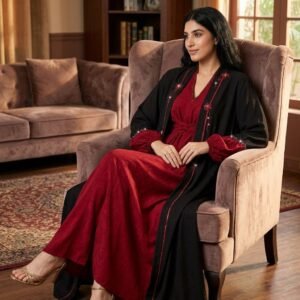
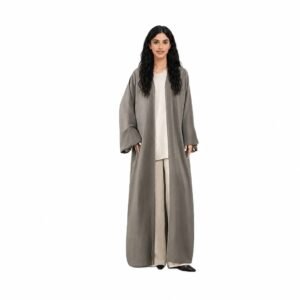
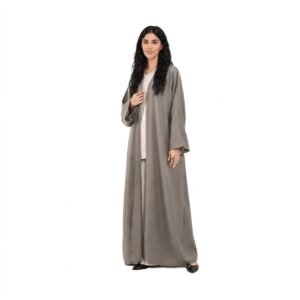
Abaya + Inner Slip Set

An open abaya paired with a matching inner slip dress or slip trousers. The most versatile pairing — both pieces work separately as well as together. Available in nida, crepe and chiffon.
Best for: everyday, modest workwear, travel

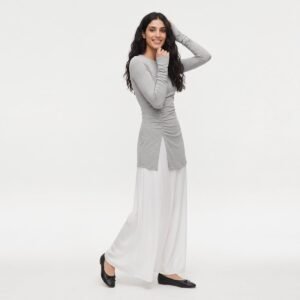
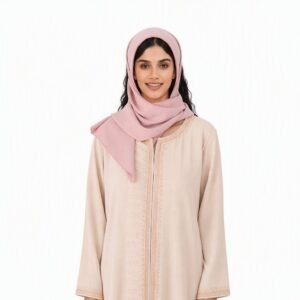
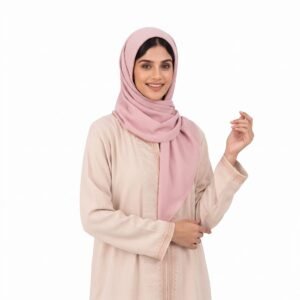
Long Tunic + Wide-Leg Trouser

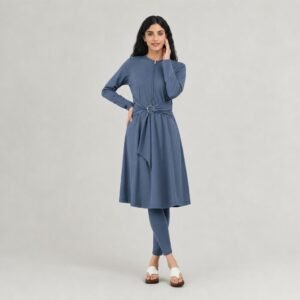
The most popular co-ord silhouette for modern modest fashion. A hip-length or knee-length long-sleeve top with matching wide-leg or palazzo trousers. Korean crepe, linen blend and moss crepe are the top fabric choices.
Best for: workwear, smart-casual, everyday

Tunic + Maxi Skirt Set

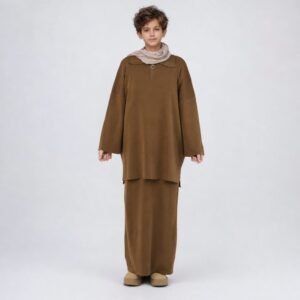
A long-sleeve top with a floor-length or midi skirt. Flared, A-line and pleated options. Works as an Eid outfit in a festive fabric, or as everyday modest wear in a neutral. Both pieces mix well with other wardrobe items.
Best for: Eid, weekend, modest casual

Modest Co-Ord Sets — Sample Products

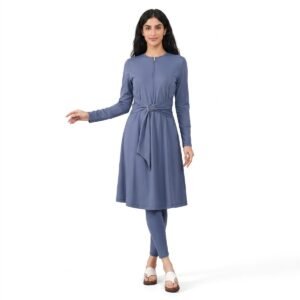
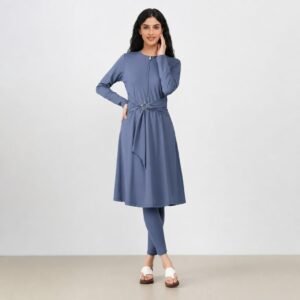
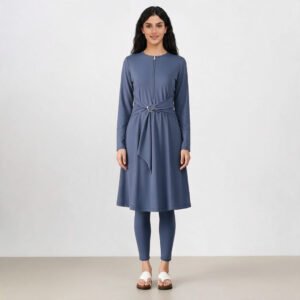
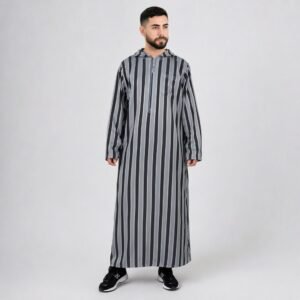
Browse our modest two-piece and co-ord sets. Custom fabric, colour and sizing available. MOQ 50 pieces per style.

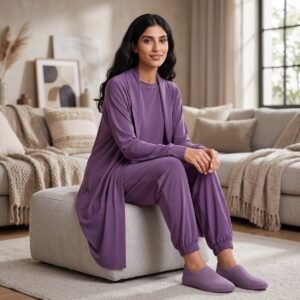
Knit Lounge & Rib Set

A matching rib-knit or jersey long-sleeve top with wide-leg jogger or lounge trouser. Designed for home, travel and casual wear. Bamboo, modal and cotton blends are the most popular fabrics.
Best for: home wear, travel, casual

Cardigan + Midi Dress Set

A matching open-front cardigan layered over a fitted midi or shirt dress. Adds coverage and a finished, polished look. Popular for conservative workwear. Both pieces function independently.
Best for: office, smart-casual

How to Choose a Modest Co-Ord Set

Everyday wear — a linen blend or Korean crepe in a neutral. Light, breathable and machine washable.

Eid or occasions — satin, chiffon or moss crepe in a festive colour, with tonal embroidery to lift the look without adding bulk.

Office — a tunic and trouser in mid-weight crepe; tailored lines read as workwear even at modest lengths.

How We Construct a Set

Three construction decisions that determine whether a set sells and reorders, or comes back at first delivery. These are fixed into our production process, not offered as upgrades.

🌈

Single Dye Lot — Both Pieces

Top and bottom cut from one continuous lot. We never split a two-piece order across lots, even when demand outpaces a single roll.

Why it matters: the most common reason a set comes back is that the top and bottom read differently under retail lighting. One lot eliminates this at the source.
🧬

Paired Wash Test Before Bulk

Both components are washed together at the pre-production stage. If one piece shrinks 2% and the other shrinks 3%, we adjust before a single bulk unit is cut.

Why it matters: mismatched shrinkage is invisible at dispatch and visible at the customer’s first wash. Fixing it post-sale means returns; fixing it pre-production costs nothing.
📏

Independent Grading Per Component

Top and bottom are graded separately, not proportionally. A size 2XL top needs a different shoulder-to-hem ratio than a size 2XL bottom needs a waist-to-hem ratio.

Why it matters: brands that go plus-size with sets see the highest fit complaints when grading is applied as a single multiplier. We show graded flat patterns on request.

What Buyers Actually Order When They Source Modest Sets

A set is not two garments sold together. It is one product with two fit points, two consumption calculations and one colour — and if any of those three disagrees between the top and the bottom, the customer returns the whole thing, not half of it. That single fact reshapes how a set has to be manufactured, and it is the reason a factory that is good at single abayas is not automatically good at sets.

We organise set production by component family rather than by a catalogue number. A two-piece abaya set, a tunic-and-trouser co-ord and a knit lounge set are all built from a top block and a bottom block that have to be developed, graded and approved as a pair — the pairing is the product, not the individual pieces. That lets you run a lounge line and a workwear co-ord line in the same order, share the size grading across both, and ship everything consolidated on one carton list.

Who orders sets from us? Mostly four kinds of buyer. A brand already selling a single abaya and looking for a bigger basket. A boutique that wants the customer to open the bag and be dressed, with no outfit to assemble. A wholesaler, because a set scans as one barcode rather than two and clears the shelf faster. And an Eid buyer who needs family matching sets — adult and kids from one fabric lot — on a date that cannot move. We work with brands across the Middle East, the UK, Europe, Southeast Asia and North America, and our commercial team handles enquiries in English and Arabic. Shipping is DDP door to door.

In the trade these products are also written as modest co-ord sets, matching sets, loungewear sets, tunic sets or jalabiya two-piece depending on the market. The construction logic is identical; only the market language changes. In muslim markets these are often called muslim co-ord sets or islamic women sets.

Two-Piece Co-Ord Set (Abaya + Inner Slip)

The best-selling set format in the UK, Europe and Southeast Asia, and the easiest upsell for a brand that already sells an open abaya. The outer is a front-open abaya; the inner is a fitted slip dress, a sleeveless column or a simple long-sleeve inner. Sold as one SKU, it removes the styling problem — the customer gets a complete, coverage-correct outfit in one purchase, and your average order value moves up without you having to acquire a new customer.

Construction notes: the two components are graded from a single size run, so the inner length is set as a fixed offset from the outer length — typically 4–6 cm shorter at the hem so the inner never drops below the abaya and shows as a second colour at the ankle. If the slip sits on the skin, the neckline facing and the armhole finish are the two places a cheap set gives itself away, so both are bound rather than overlocked. The outer keeps a clean folded-and-topstitched front edge; the inner is usually cut from a lighter-weight version of the same fabric for drape under the abaya.

Typical fabric: Korean crepe, Japanese crepe, moss crepe, satin, and a matching lighter crepe for the inner. The inner is often the same fabric at a lower weight so the two layers move together instead of fighting.

Three-Piece Co-Ord Set (Abaya + Slip + Belt)

The premium and occasion format, and the highest-margin set we produce. Three components: an outer abaya, an inner dress or slip, and a third piece — most often a self-fabric belt, a short shrug, a longline cardigan or a matching scarf. Three pieces photograph as a collection and justify a retail price point that a plain abaya can never reach, which is why Gulf occasion wear and Eid collections run heavily into this format.

Construction notes: a three-piece set is where lot control stops being a preference and becomes a hard requirement — all three components must come from one dye lot, because a belt cut from a second roll will read visibly different at the waist even when the colour code is identical. The belt has to be interfaced and bar-tacked at the closure so it does not fold over on the wearer, and the shrug is graded so its hem sits at a defined point on the abaya rather than wherever the pattern happened to land. Because three components mean three times the sample risk, we always shoot an assembled sample photo set before bulk and send it to you for approval against the whole look, not component by component.

Typical fabric: nida, Japanese crepe, satin-back crepe, moss crepe, chiffon for the third piece.

Co-Ord Top & Wide-Leg Trouser Set

The workwear and smart-casual set — a longline tunic, shirt or boxy top with matching wide-leg trousers. This is the format that converts a modest brand from occasion wear into a daily wardrobe brand, and it reorders far more predictably than anything else in the range because it has a season-neutral price point and a repeat purchase cycle. Retail price points typically run £45–95 in the UK and $60–120 in the US.

Construction notes: the top is cut with a straight or slightly A-line body and a deep hem facing so it hangs correctly over the trouser waistband without clinging. The trouser is where the construction budget should go: a wide leg needs a pressed centre crease, a faced waistband rather than a simple elastic one at the mid-and-premium tiers, and either a side zip or a hidden front zip — a plain elastic waist reads as loungewear and caps your price. Seat depth and rise are graded separately from the waist so the trouser does not pull across the hip on larger sizes, and the two components are checked on a mannequin together to confirm the top hem clears the waistband by 3–5 cm in every size. Ponte, crepe and linen blend are the three fabrics that hold a wide-leg crease; a lightweight jersey will not.

Typical fabric: ponte, crepe, linen blend, twill, heavy viscose.

Knit Lounge Set (Rib & Jersey)

Relaxed, high-volume, extremely repeatable. A ribbed or jersey top with matching wide-leg trousers, palazzo pants or a midi skirt, in cotton-modal, rib knit, brushed fleece or a soft poly-spandex. The lounge set is the fastest-turning product in most Western modest catalogues because it sells on comfort and it sells in winter — it is not a Ramadan-only item, which makes it the SKU that keeps cash moving through the quiet months.

Construction notes: the defining problem with a knit set is differential shrinkage. A 2×2 rib top and a single-jersey bottom shrink at different rates through the first wash, and a set that matched on delivery no longer matches after the customer wears it once — which is exactly when she leaves the review. We compact and pre-shrink both components against the same shrinkage curve and wash-test the pair together, not separately. Cuffs, hems and the waistband carry the same rib so the set reads as designed rather than assembled. Heavier fabric weight matters more here than anywhere else: below 200 g/m² a light colour lounge trouser will show the leg line, so we test opacity on the trouser panel specifically, in daylight, on the assembled garment.

Typical fabric: 2×2 rib knit, cotton-modal jersey, brushed fleece, French terry, poly-spandex.

Modest Skirt Set (Top + Maxi or Pleated Skirt)

A top paired with a matching maxi skirt, pleated skirt or A-line skirt. Popular in Southeast Asia and increasingly in Western markets, and it is the format that photographs best on social — the silhouette is distinctive and it moves well on camera. It also has the simplest size story of any set we build, because the skirt is the forgiving component and the top carries the fit.

Construction notes: the skirt needs a full or partial lining — a single-layer skirt in a light fabric will backlight in daylight and fail the coverage test that the whole modest category is built on. The waistband is the technical decision point: an elasticated band is cheaper and works for lounge, a flat faced band with a side zip is what a mid-market or premium buyer needs. Pleats must be set and heat-fixed before assembly, or they collapse after one wash and the skirt loses its shape permanently. The top hem is graded to clear the skirt waistband by at least 3–5 cm so nothing gaps when the wearer raises her arms, and on a pleated style we check the pleat pitch against the top's width so the set reads as one design rather than two garments in the same colour.

Typical fabric: crepe, moss crepe, viscose, ponte, satin-back crepe, linen blend.

Cardigan + Dress Set (Two-Piece Layer Set)

A dress with a matching longline cardigan — essentially an open abaya split into two wearable pieces, and the most versatile set in the range because both components sell as separates if the pairing does not work. Buyers like it because the cardigan can be worn over other outfits and the dress on its own, which doubles the perceived value at almost no extra cost to you.

Construction notes: the two components must be graded together so the cardigan's front panels fall at a defined point relative to the dress, not randomly. The dress is lined or double-layered in the body where the fabric is light, with a defined neckline that sits correctly under the cardigan. The cardigan gets a folded-and-topstitched front edge or a bound edge with optional contrast piping, and the armhole is set slightly lower than a fitted jacket so it layers over the dress without pulling. Because this set is often sold with a self-fabric belt, we strike the belt from the same lot as both components and bar-tack the belt loops on the cardigan so the belt is presented, not loose in the bag.

Typical fabric: Korean crepe, Japanese crepe, rib knit (for a knit version), nida, ponte.

Eid Family Matching Set (Adult + Kids)

The most date-sensitive product on this page. A family set is graded across adult and kids sizes from a single design — mother, daughter and often father in a coordinated fabric and colourway. It sells on one specific occasion and it sells against a date that does not move: if the goods land after Eid, the buyer has dead stock, no matter how good the quality is.

Construction notes: everything on this page about single-lot control applies with more force here, because a family photograph puts four garments from four different size ranges side by side in the same frame — any shade drift between the adult and the kids components is instantly visible and cannot be hidden. We cut all sizes, adult and kids, from one lot and one spread, and we grade down to 2T with the same construction standard as the adult sizes: bound neckline, finished hem, no shortcuts that only show on the child's garment. Kids sizes carry their own care label, their own hangtag and their own barcode, packed as a family unit or as individual sizes depending on how you sell. Adult sizing runs XS–3XL and kids runs 2T–14Y; mixed adult-and-kids cartons are packed with the family grouping marked on the carton, so a retailer can pull a complete family set without opening three boxes. Book these 8–10 weeks before Eid — the calendar, not the factory, is the constraint.

Typical fabric: nida, crepe, satin, cotton-poplin (kids), viscose blend. Kids components are usually cut from a lighter weight of the same fabric so the child's garment is not stiff.

Fabric Guide — What Each Set Fabric Actually Does

Fabric decides 60–70% of how a set is judged, and most of what it costs. On a set it also decides whether the two components still behave the same way after the first wash — which is the part a spec sheet will not tell you. The table below is what we hold and produce regularly for set programmes, with the weight ranges we actually buy rather than catalogue minimums. Something outside the table? We source to your specification.

Fabric Weight Handle Best for Price tier
Crepe (poly / Korean)150–210 g/m²Matte, fluid, low creasing, holds colourTwo-piece abaya sets, co-ord trousers, skirt setsEntry–Mid
Jersey Knit (single)160–200 g/m²Soft, stretchy, drapes close to the bodyLounge sets, inner slips, everyday co-ordsEntry
Linen Blend (linen/viscose)180–220 g/m²Breathable, natural texture, creases by designSummer and resort co-ord setsMid
Viscose / Viscose Twill120–170 g/m²Excellent drape, cool hand, shrinks unless compactedSkirt sets, wide-leg trousers, drape-heavy topsEntry–Mid
Ponte (double knit)280–340 g/m²Substantial, holds shape, does not cling, presses wellCo-ord top & wide-leg trouser setsMid–Premium
Rib Knit (2×2 / 4×4)220–320 g/m²Stretch recovery, structured, texturalKnit lounge sets, cardigan + dress sets, cuffs and waistbandsMid
Cotton-Modal180–240 g/m²Soft, breathable, very low pillingPremium lounge sets, kids componentsMid–Premium
Poly-Spandex (performance)200–260 g/m²Four-way stretch, moisture-wicking, opaque at weightModest activewear sets, sports co-ordsMid
Brushed Fleece / French Terry260–340 g/m²Warm, soft-backed, holds a relaxed shapeWinter lounge sets, UK and European marketsMid
Satin-Back Crepe160–220 g/m²Lustrous face, matte back, shows every seamEid occasion sets, three-piece sets, skirt setsPremium

Opaque or not? On a set, answer it twice — once for the top, once for the bottom. The same fabric can pass on a bodice panel and fail on a full-length trouser leg, where light passes behind a single layer with nothing to break it, and that one failure sends the whole set back. A 190 g/m² crepe in a dark colour is fully opaque; a 160 g/m² jersey in ivory is not, in any weight that still feels like jersey. So we test opacity on the assembled garment in daylight, both components, before bulk cutting, and we tell you the result before production rather than after.

Matched shrinkage between components. The second question unique to sets. If the top is a rib knit and the bottom is a single jersey, they will shrink at different rates even when they started out the same colour. We either compact both against the same curve or match the components by construction — and whichever route we take, both pieces are wash-tested as a pair and the results go into your spec sheet so a reorder reproduces the same behaviour.

What You Can Customise on a Set

Number of Pieces
Two-piece, three-piece or four-piece. Add an inner slip, a self-fabric belt, a shrug, a longline cardigan or a matching scarf. Each added component is graded and cut from the same lot as the rest of the set.

Top & Bottom Length
Top from cropped to tunic to midi length; bottom from midi to full-length, with the top hem graded to a fixed offset from the waistband so nothing gaps in any size. Length pairing is fixed in the pattern, not adjusted at cutting.

Sleeve Type
Straight, tapered, bell, flared, balloon, cuffed, split or sleeveless. Sleeve length and fullness are graded to your market — Western buyers usually want a longer, closer sleeve than Gulf buyers.

Neckline & Collar
Round, V, scoop, band collar, mandarin or faced boat neck. A faced or bound neckline is the default on any component worn against the skin, and on inner slips it is never overlocked.

Waistband Type
Elasticated, flat faced band, drawcord, elasticated-back with flat front, or a paper-bag waist. The waistband is the single detail that decides whether a trouser reads as loungewear or as workwear — choose it against your price point.

Colour Coordination
Tonal (top and bottom same shade) or two-tone (defined contrast). Two-tone sets need both shades lab-dipped and approved as a pair in one round, not separately, because the contrast reads differently under indoor light than in daylight.

Packaging
Both components folded to a single footprint and bagged as one retail unit with one barcode, or bagged separately for stores that merchandise them apart. Folded flat pack, hanger pack, tissue wrap and branded box all available.

Branding
Woven neck label, care and composition label, hangtag, printed polybag, size sticker and gift box — all under your brand, with no reference to our factory anywhere on the finished product.

OEM vs ODM vs Private Label for Set Ranges

Sourcing agents use these three terms as though they were interchangeable. They are not. On a set the difference bites harder than on a single garment, because whichever route you take, two components still have to be developed as a pair — and the arrangement you pick sets what you hand over and how long development takes. It also decides how much of the design you end up owning.

  OEM — Your Design ODM — Customise Ours Private Label
Who designs itYouWe hold the base set, you modifyEither — label only
What you supplyTech pack, measurements, fabric spec for both componentsReference or selectionLogo artwork
Minimum50 sets per style50 sets per style50 sets per style
Development time3–5 weeks (two patterns + proto set)7–10 days (modify existing pair)None — label artwork only
Who owns the designYou, exclusively — both componentsYou own your version; base set stays oursBase is shared; label is yours
Best whenYou have a silhouette worth protecting and repeat volume behind itYou want speed to market at low risk, or you are adding a second categoryYou are testing whether sets sell in your market before investing in design

An honest note on private label: it is the fastest and cheapest way to launch, and it is the most fragile position to hold. If your set is a stock base with your label on it, a competitor can buy the same base and undercut you — and because a set is easier to copy visually than a single abaya (a customer can see the whole look in one photo), the undercutting happens faster. That is fine for a test order. It is not a business. Brands that survive their second season almost always move to ODM and then to OEM, because that is where the product stops being interchangeable.

Size Chart — Set Grading

Sets are graded across a single size run so the top and the bottom stay in proportion at every size — the top length and the bottom rise are set as fixed relationships in the pattern, not adjusted at cutting. Below is our standard women's curve for a longline top with a wide-leg or maxi bottom. Gulf buyers often run a length-based curve instead; Western and Southeast Asian buyers normally use this XS–3XL dress curve. We can hold both curves on one production run.

Size UK / US EU Bust (cm) Waist (cm) Hip (cm) Top length (cm) Bottom length (cm)
XSUK 6 / US 23482649078100
SUK 8 / US 43686689479101
MUK 10 / US 63890729880102
LUK 12 / US 840957710381103
XLUK 14 / US 10421008210882104
2XLUK 16 / US 12441068811483105
3XLUK 18 / US 14461129412084106

Tolerance ±1 cm on all measurements. Kids sizes for family sets run 2T–14Y on a separate curve graded from the same adult design. Custom grading to your own size curve is included at no extra cost — send us your spec sheet and we will build the pattern set from it. Mixed-size pairs (for example top M / bottom L) are available as a made-to-order option with a small upcharge.

Pricing: MOQ and Lead Times by Set Type

Indicative FOB pricing, China, per set, with every component included. Final pricing comes off your specification: fabric, weight, how many components the set carries, and how it is built all shift the number further than volume will. A set costs more per unit than a single abaya because it is two or three garments in one — but it captures the customer’s whole outfit spend in a single purchase.

Set type 50–199 sets 200–499 sets 500–999 sets 1000+ sets
Knit lounge set (2 pc, jersey / rib)$22.50$19.80$17.60$15.90
Two-piece abaya set (crepe + inner)$27.80$24.60$22.10$20.40
Co-ord top & wide-leg trouser (ponte)$29.50$26.20$23.70$21.80
Modest skirt set (top + lined maxi)$28.40$25.10$22.80$20.90
Cardigan + dress set$31.00$27.60$24.90$22.70
Three-piece set with inner + belt$38.50$34.20$30.60$27.90
Eid family matching set (adult + kids pair)$44.00$39.50$35.20$31.80

What sits inside the price: fabric for every component, cutting, sewing, finishing, linings and facings, your woven label and care label on every component, hangtags, the set packed as one retail unit, and export carton. What sits outside it: freight, import duty, and any local testing your market requires. On DDP terms we quote you one landed number with duty included, so there are no surprises at customs.

Lead times — sample set in 7–10 days once your specification is confirmed. For OEM work where we develop both patterns from scratch, allow 3–5 weeks before a sample ships. Bulk production 30–45 days from sample approval, depending on component count and construction. Reorders on an archived specification run 12–18 days. Eid family sets and three-piece occasion sets must be booked 8–10 weeks ahead of the date — the constraint on these is capacity in the embroidery and belt-making lines, not fabric.

How a Set Order Runs

Enquiry
Send your specification, or a reference garment or tech pack for both components. Tell us the market you sell into, the retail price you aim at, and the date you need the goods — those three shape the quote. We come back with fabric options for top and bottom together, plus an indicative set price, usually within 8–12 hours.

Sample
We produce a proto set — both components — in 7–10 days. For OEM work we develop two patterns first, so allow 3–5 weeks before a sample ships. You approve the set as an assembled look, not component by component. The sample fee is credited against your production order.

Confirmation
Quantities, size ratios, colours, the component list and the price go into a written agreement, and the 30% deposit starts production with 70% due before shipment. We confirm the size ratio against your sell-through plan now, not in the cutting room.

Production & QC
30–45 days. We check inline through cutting and sewing, book a documented 3-point inspection once the run is 30% complete, add a component-pairing check before packing, and finish with an AQL 2.5 inspection. Every check is photographed.

Shipping
DDP door to door with the duty already in the price, or FOB if you have your own forwarder. Sets leave as one carton list with the family or colour grouping marked on the carton, so a retailer can pull a complete unit without opening three boxes.

Reorder
Your two patterns, specification, shrinkage test results and approved shade band stay archived. A reorder on the same spec runs 12–18 days and is matched against the physical sample and the original lot reference, not a description.

Quality Control — What We Check on a Set, and When

Set QC has four failure modes that matter more than general workmanship: top-to-bottom shade matching, component shrinkage parity, size pairing consistency, and opacity on both components. Each is checked at a different point in production, and each is expensive to fix after the goods ship — because with a set you cannot replace half of it and leave the customer with a usable product.

Top-to-bottom shade matching is the number one defect in this category, and the number one reason a set comes back. It is not a workmanship error — it is a lot control error, and it can happen even when both components are the correct colour code. A top cut from roll A and a bottom cut from roll B will read identically on the cutting table and differently on the customer, because indoor lighting and daylight flatter fabric differently and because dye lots vary within a single colour code. Our control is simple and non-negotiable: every component of a set is cut from the same dye lot and the same spread. If the order is too large for one lot, we cut and pack sequentially from each lot — we never mix a top from one lot with a bottom from another to fill a size gap. We also strike a physical shade band from your approved lot and keep it on file, so the reorder is matched against a physical reference rather than a description. If a second lot is unavoidable on a reorder, we send you a side-by-side photo of old against new before cutting, and you decide.

Component shrinkage parity applies to knit and viscose sets. A rib top and a jersey bottom, or a viscose top and a crepe bottom, will shrink at different rates through the first wash. We wash-test the assembled pair — not the fabric swatches — and record the results. Where the two components cannot be brought onto the same curve, we tell you before production and propose a fabric substitution rather than shipping a set that stops matching after one laundry cycle.

Size pairing consistency is a logistics failure, not a sewing failure, and it is the one buyers underestimate. A set order is not 500 tops plus 500 bottoms — it is 500 sets in a defined size ratio, and if the ratio is wrong you finish the run holding orphan tops that cannot be sold as a set. We cut against a component matrix by size pair, track the balance component-by-component through production, and confirm the ratio with you in writing before cutting. Mixed-size pairs are produced to a separate matrix and bagged as a marked pair so they cannot be pulled into the standard run by mistake. Every packed set is checked that the two components carry the same size, and that both carry the correct label and size sticker.

Opacity and hem levelness are checked the same way as on any garment but applied to both components: opacity on the assembled trousers and the assembled top, in daylight, before bulk cutting of the balance; hem levelness on a mannequin rather than on the table, because a wide trouser leg or a flared skirt hem that measures level on the table can hang visibly uneven once it is on a body, and a table check will not catch it.

Final inspection runs to AQL 2.5 as standard, with defect thresholds agreed in writing before production. If a lot falls outside the agreed threshold we remake it or agree a compensation, per the terms confirmed on your order. Inspection is photographed — component shots, the packed set, and the shade comparison — and the images go to you before the balance payment is due, so you are approving against evidence rather than a description. If a third-party inspection is required by your market or your buyer, we cooperate with the nominated agency and schedule it into the production calendar before the run starts — SGS, Bureau Veritas and Intertek have all inspected on our floor.

Who Orders Modest Sets From Us

Modest fashion brands

50–200
sets per style

Typically 50–200 sets per style, 2–4 set styles per drop. Priority: exclusive design, a top-and-bottom pairing that photographs as one look, and a finish that holds up under a customer's camera. Most start with ODM and move to OEM by their second collection.

Wholesalers & distributors

300–2,000
sets per style

300–2,000 wholesale muslim sets per style on repeat. Priority: consistent unit cost, identical reorders, correct size ratios, and predictable delivery dates. Sets suit wholesale because one barcode turns stock faster than two.

Online retailers & boutiques

100–500
sets

100–500 sets, often with gift packaging and private label. Priority: retail-ready packaging, one-barcode packing that works with your 3PL, and low minimums for testing new set styles.

Eid & seasonal collections

Fixed date
one large single run

Large single-run orders on a fixed date — three-piece occasion sets and family matching sets. Priority: hitting a hard calendar date, and lot control across every size and component. Confirm 8–10 weeks before Eid.

Shipping Sets — DDP, Duties and Payment

Shipping. DDP door to door, with import duty worked into your quotation before you agree to anything, so there is no second invoice waiting at the port. Prefer to clear your own goods? We coordinate FOB and CIF with your forwarder instead. Air freight runs 7–12 days door to door, sea freight 25–40 days depending on destination. Inside the export carton each set is packed as one retail unit, and the carton list shows the set grouping — your warehouse receives outfits, not loose tops and bottoms.

Duties. Sets are classified under the HS code for women's woven or knitted garments, and the rate depends on the destination, the fabric composition and — on a set — how the components are classified together. We confirm the classification and the applicable rate on your quotation, in writing, before you commit to a price, and we can provide the composition breakdown per component if your customs broker asks for it.

Payment. 30% deposit to begin production, 70% before shipment — the balance falls due once your goods are finished and photographed, not before. Bank transfer is standard. PayPal and card payment are accepted for sample fees. Documents are issued in the name you nominate, and we are happy to work through your own sourcing agent if you have one.

Proven With Real Muslim Women's Sets Buyers

Two completed muslim women sets buyer relationships — one built around an everyday two-piece set, and one testing a mixed abaya, prayer-set and two-piece range at 50 pcs per style.

Oman

Independent Online Store

Result
Store's #1 SKU
Store's #1 SKU · stable monthly sales with ongoing reorders
“The sets are practical enough for home and outside wear, and repeat purchase is strong.”
Route
ODM women's set, top plus midi skirt or wide-leg trouser combination, multiple colourways, mixed-batch order
Riyadh, Saudi Arabia

Shopify DTC Brand

Result
32% repeat rate
8 SKUs live · 32% repeat rate · 1,200+ pcs per quarter by Eid
“One factory for abayas, prayer sets and two-piece sets meant we stopped juggling three suppliers. Starting at 50 pieces let us test the range without overcommitting.”
Route
ODM · Abaya, prayer sets and two-piece sets, mixed in one order at 50 pcs per style

Frequently Asked Questions

Is your minimum order counted per set or per piece?

Per set. 50 sets per style and colour is the minimum, and each set counts as one unit no matter how many components it contains — a three-piece set and a two-piece set both count as one against the minimum. Sizes are mixed freely within that minimum; we do not multiply the minimum by size. Each colour needs its own dye lot, so each colour carries its own 50.

How do you stop the top and bottom being different shades?

By cutting every component of a set from the same dye lot and the same spread, and by striking a physical shade band from your approved lot that we keep on file. This is the single most important control in set manufacturing — shade mismatch between components is the number one return reason in the category, and it happens even when both pieces carry the correct colour code, because dye lots vary and indoor light flatters fabric differently from daylight. Where an order is too large for one lot, we cut and pack sequentially from each lot rather than mixing a top from one lot with a bottom from another.

Can the top and bottom be different sizes within one set?

Yes. Mixed-size pairs — for example top M with bottom L — are available as a made-to-order option with a small upcharge. They are cut against a separate component matrix and bagged as a marked pair so they cannot be pulled into the standard run by mistake. Tell us the ratio you need at quotation stage so we can build the cutting plan around it.

What is the difference between a two-piece abaya set and a co-ord set?

Ask which one your customer is dressing for. A two-piece abaya set is an open abaya over an inner slip — the outer layers, the inner does the covering, and each can be worn with something else. A co-ord set is a top and a bottom of equal visual weight, usually a tunic or longline top with matching wide-leg trousers or a skirt, worn on its own rather than layered. Different silhouettes, different customers — which is why we draft two separate patterns instead of treating one as a variant of the other.

Do knit sets shrink differently between the top and the bottom?

They can, and this is the most common quality complaint on knit sets. A 2×2 rib top and a single-jersey bottom shrink at different rates through the first wash, so a set that matched on delivery stops matching after the customer wears it once. We compact and pre-shrink both components against the same shrinkage curve, or match the components by construction, and we wash-test the assembled pair rather than the fabric swatches. The results go into your spec sheet so a reorder reproduces the same behaviour.

How are the pieces packed — as one retail unit or separately?

Both options are available, so pick by how you merchandise. The default is one retail unit: every component folded to a single footprint, bagged together under one barcode, so the customer opens a complete outfit and your 3PL handles one SKU. If your store merchandises tops and bottoms apart, take individual bagging with separate barcodes instead. Hanger pack, folded flat pack, tissue wrap and branded gift box are all available, and the polybag is cut to the actual fold so there is no spare film in the pack.

Can you produce three-piece sets with an inner slip and a belt?

Yes. Three-piece sets are the highest-margin format we produce — an outer abaya, an inner dress or slip, and a third piece such as a self-fabric belt, shrug, longline cardigan or matching scarf. All three components come from one dye lot, and we shoot an assembled sample photo set before bulk so you approve the complete look rather than individual components.

Do you make Eid family matching sets in adult and kids sizes?

Yes. We grade a single design across adult XS–3XL and kids 2T–14Y, cutting all sizes from one lot and one spread so nothing drifts in shade between the adult and the child's garment — which matters because a family photograph puts them side by side and any drift is instantly visible. Kids components carry their own care label, hangtag and barcode. Book family sets 8–10 weeks before Eid; the constraint is the calendar and embroidery capacity, not fabric.

Which fabric do you recommend for a lounge set at a mid price point?

Cotton-modal at 200–240 g/m² for the top and bottom if your market expects a natural hand, or a 2×2 rib at 260–300 g/m² if you want the set to read as structured and premium in a photo. Below 200 g/m² a light-coloured lounge trouser will show the leg line on a single layer, so we test opacity on the assembled trouser in daylight before bulk cutting and tell you the result before production rather than after.

Can I order mixed set styles in one shipment?

Nearly every brand we ship to does. Put several set styles on one order and they share the size grading and leave in one shipment, which is what pulls the freight cost per unit down. Minimums run per set style and colour, not per order. There is a second gain on a set that you do not get on a single garment: with more components in play you can balance consumption across styles and waste less fabric on the small runs.

Do you offer exclusivity on set designs?

For OEM designs, exclusivity is automatic — we do not produce your design for anyone else, and that covers both components. For ODM styles, we can agree category or territory exclusivity on request, subject to volume. Ask at quotation stage rather than after your first order, because territory exclusivity is priced against expected annual volume.

What are your sample and production lead times for sets?

A sample set, both components, in 7–10 days from a confirmed specification. OEM work from scratch takes longer — two patterns have to be developed before anything can ship, so allow 3–5 weeks. Bulk runs 30–45 days from sample approval, and the component count and construction decide which end of that you land on. Reorders against an archived specification run 12–18 days. Three-piece and Eid family sets need 8–10 weeks of runway.

What is a modest co-ord set?

In wholesale markets you will also see it written as muslim two piece sets. It is a two-piece outfit: top and bottom cut to be worn together, matched in fabric, colour and print — usually a long-sleeve tunic or top over wide-leg trousers, a maxi skirt or leggings, covering from neck to ankle. The reason it sells is that both halves still work alone, which makes the set easy to wear every day, on occasions and when travelling.

What is the difference between a co-ord set and a two-piece set?

The two terms get used interchangeably, and in modest fashion they usually point at the same thing: a long-sleeve top with matching full-length bottoms. Co-ord is short for coordinated and tells you the pieces match in fabric and colour; two-piece tells you the count. Add a third element — typically an inner slip, a belt or a cardigan — and you have a three-piece set, which is a different product to price and to pack.

What fabrics work best for modest co-ord sets?

Match the fabric to the wearer’s week. Korean crepe, linen blend and moss crepe suit everyday — breathable, structured, machine washable. Chiffon with lining, satin and duchess satin are for Eid and occasions: more lustre, and they carry embellishment better. Rib knit, jersey, modal and bamboo blends are the casual and home-wear picks. One rule cuts across all of them: avoid anything that clings or shows its texture under a hijab layer, because good modest co-ords fall cleanly and keep their coverage when the wearer moves.

Can I order a modest co-ord set in my own colour or print?

Yes. ModestRise manufactures custom co-ord sets with your chosen fabric, colour (dyed to Pantone), print or embroidery design. Minimum order is 50 pieces per style per colour. Samples are available in 7-10 days. We also offer ODM options where you select and modify from our existing blocks — the fastest route to a branded modest set with the lowest design overhead.

Can I reorder just the tops if the top sells out faster than the bottom?

Yes. We manufacture the top and bottom as independent garments and can reorder either piece separately at the standard MOQ of 50 pieces. For the colour match to hold, you need to reference the original fabric code from your order — if we still have that fabric in stock, the lot-to-lot variance is minimal. If the fabric has turned over, we will send a strike-off against your original colour reference before cutting the reorder. Half-set reorders work best when initiated within 6 months of the original order; beyond that, dye lot continuity cannot be guaranteed.

My customers need a size M top with a size L bottom — can I order the set in split sizes?

Yes. Because we grade the top and bottom independently, your size run can specify different top and bottom sizes per unit. A typical split-size order might read: “M top / L bottom × 40, L top / L bottom × 60, L top / XL bottom × 40.” Just list the combinations and quantities in your inquiry form and we will confirm the cutting plan before production. There is no extra charge for split-size combinations as long as the total per style meets the 50-piece minimum. If you are unsure of the right split ratio, ask for our size distribution guide — we track what ratios reorder most frequently by market.

Do cotton co-ord sets create any US customs risk?

Cotton garments shipped from China can be checked under the Uyghur Forced Labor Prevention Act. We use non-Xinjiang cotton with traceable origin for cotton and cotton-blend sets, so the paperwork is ready before the shipment reaches the port.

Why Order Direct From the Factory

Most buyers looking for a muslim sets manufacturer still route orders through a sourcing agent or a marketplace. Here is what changes when you order factory-direct.

Factory Direct
ModestRise
Trading Company
sourcing agent
B2B Marketplace
Alibaba / etc.
MOQ per style50 pcsOften 100–300 pcs
agent adds minimum
Varies widely
quoted after negotiation
Published pricingYes — FOB price table on this pageNo — agent marks up and quotes separatelyRFQ only — prices vary per inquiry
Sample turnaround7–10 days10–21 days
routing through intermediary
Varies by factory
Pattern modificationsDirect with our pattern teamVia agent — feedback loop adds roundsFactory decides — no direct access
Logo & private labelOEM & ODM from 50 pcsUsually available, higher costAvailable, minimum varies
Quality control accessPre-production, inline & final — reports sharedAgent may or may not attendLimited — buyer rarely has direct QC access

Get a Modest Co-Ord Set Wholesale Quote or Sample

Contact Form Demo

Why Request a Quote From Us

  • ✓Low MOQ — from 50 pcs per style/colour
  • ✓OEKO-TEX® Standard 100 & GRS 4.0 certified fabrics available on request
  • ✓Full OEM / ODM & Private Label — your design, labels & packaging
  • ✓DDP worldwide shipping — door to door, duty included
  • ✓We reply with pricing usually within 8–12 hours

What to Include in Your Inquiry

  • Style / product type (abaya, hijab, burkini, activewear, prayer dress, etc.)
  • Order quantity per style/color
  • Preferred fabric or material
  • Branding needs (custom label, hangtag, packaging)
  • Target price range

A reference photo or sketch works faster than a written description.

Prefer to talk directly?

WhatsApp: +86 13372169755

Email: abby@modestrise.com