50 pcs
Minimum order per style and colour
Hood in the pattern
Hood engineered as part of the cut, not added afterwards
8–12hr Reply
We reply to every inquiry within 8–12 hours
From $15.40
FOB factory price per piece
7–10 days
Sample lead time
25–35 days
Bulk production after sample approval
OEKO-TEX® & GRS
Certified fabrics on request
DDP Worldwide
Door-to-door with duties included
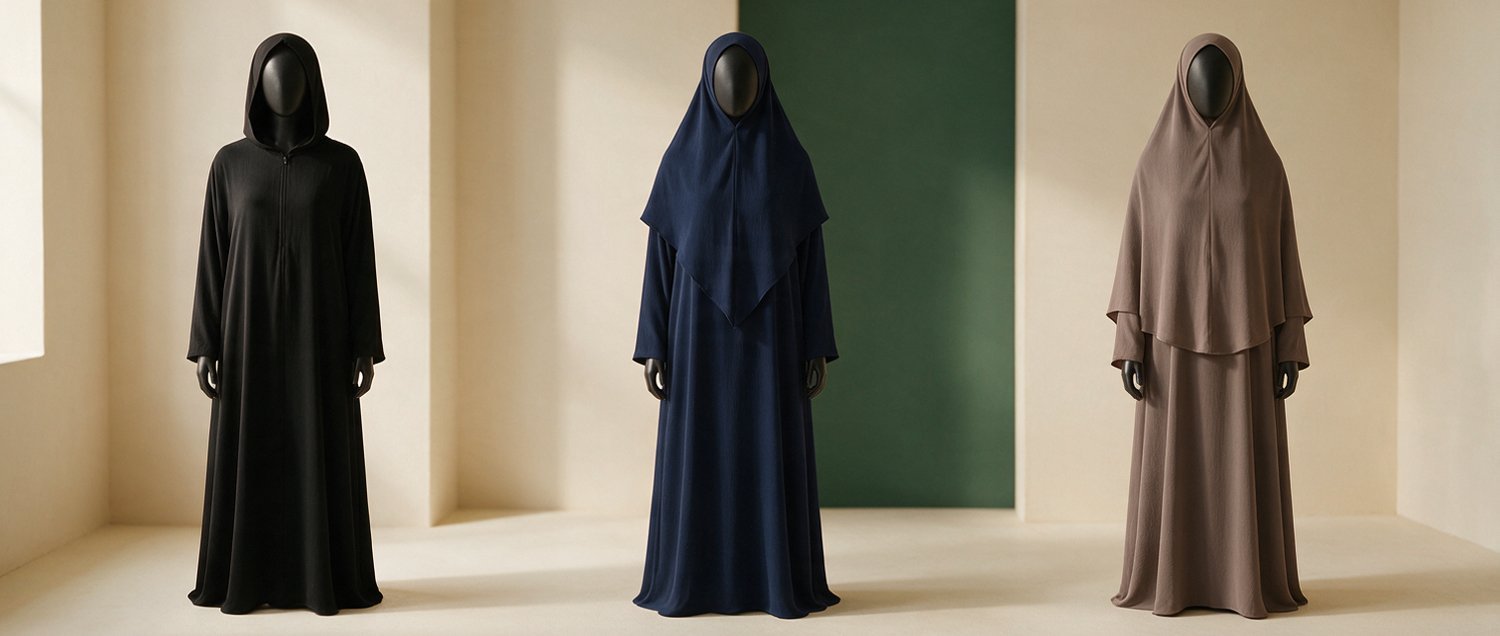
A jilbab is not an abaya with a hood added
Buyers who source jilbabs after working with abaya suppliers often run into the same issue: the factory treats it as an abaya with a hood added and calls it done. The result is a garment where the hood is proportioned for an abaya silhouette — too flat, or placed too far back — and the coverage when walking or in wind is incomplete.
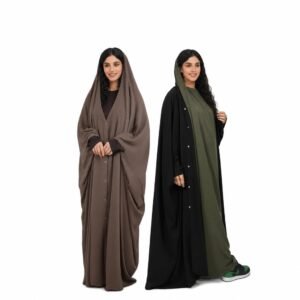
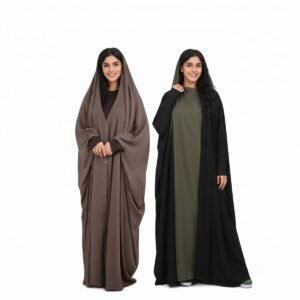
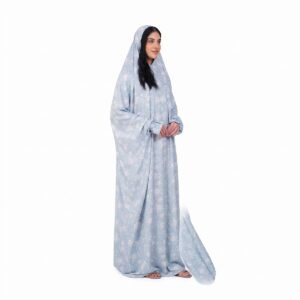
A properly constructed jilbab has a hood engineered as part of the pattern, not added as an afterthought. The front-to-nape measurement, the hood depth, the way the front panel closes over the chest, and the hem sweep are all built for a garment intended to cover fully, not layer decoratively.
We have produced jilbabs for buyers in the UK, US, and Gulf markets who require this level of coverage integrity, and the patterns we use reflect that.
We also see this from the repair side. Brands occasionally bring us jilbabs made by another factory and ask us to correct them, and the faults repeat: a badly shaped hood that slips back as soon as it is worn, front panels cut out of line so the garment never drapes, and fabric so thin it shows through.
The fabric usually passed inspection at first glance. What made the jilbab uncomfortable by evening, or during prayer, was the cut and the stitching underneath it.
A note on terminology: in Southeast Asia, particularly Indonesia and Malaysia, “jilbab” typically means headscarf. If you are sourcing headscarves for those markets, see our Hijab Manufacturer page. This page covers the full-body outer garment used in Middle Eastern, Western, and Gulf modest fashion contexts.
| Production Specifications | |
|---|---|
| MOQ | 50 pcs / style / color |
| Price range | From $15.40 FOB |
| Sample lead time | 7–10 days |
| Bulk production | 25–35 days post-approval |
| Hood / closure styles | +3–5 days |
| Certifications | OEKO-TEX®, GRS, BSCI, ISO 9001 |
| Shipping | DDP (US, UK, EU, UAE, MY, AU) |
| Payment | 30% deposit / 70% pre-shipment |
Who Orders Jilbabs From Us
Modest fashion brands
Typically 50–200 pieces per style, 2–4 styles per drop. Priority: exclusive design, fabric quality, and a finish that stands up to close-up photography. Most start with ODM and move to OEM by their second collection.
Wholesalers & distributors
300–2,000 pieces per style on repeat. Priority: consistent unit cost, identical reorders, and predictable delivery dates so shelves never empty — which means booking the run before your peak season, not during it.
Online retailers & boutiques
100–500 pieces, often with gift packaging and private label. Priority: photography-ready product, retail-ready packaging, and low minimums for testing a new silhouette before committing to a full range.
What Jilbab Wearers Ask For
Most of what women say about jilbabs is about the front: how it closes, how far the zip runs, and whether it still covers the chest when they move. Those are construction decisions, so they belong in your specification.
| What wearers say | What to specify |
|---|---|
| “It’s better if it has a hidden zipper that reaches all the way up until like the base of your throat.” — r/Umrah | Zip length and position: a concealed front zip that runs to the base of the throat, so the jilbab closes fully without a gap at the neck. |
| “Jilbabs/Abayas with a zipper in front are a must have! If the abaya isn’t spacious enough or the vertical zipper isn’t long enough…” — on nursing-friendly styles, r/Niqabis | For a nursing line, a long front zip and enough ease through the bust, graded per size rather than taken in on smaller sizes. |
| “Jilbab actually accentuates the chest area for women with large chests. An abaya and khimar covers a lot better for many sisters.” — r/SistersInSunnah | The front panel and hood length over the chest: a hood that falls lower at the front, or a two-piece jilbab with a longer headpiece, for customers who want more coverage. |
| “Zipper abayas are more functional and easier to wear.” — r/Hijabis | Offer a zip-front version next to button-front styles; the zip sells for daily wear and travel, the buttons for occasion and Eid ranges. |
Ready-stock jilbabs or your own?
Wholesalers in Turkey and Pakistan sell jilbabs from stock in small quantities, and for testing a few colours that is the faster route. A factory makes sense for wholesale jilbabs when you want the details above — zip length, hood depth, bust ease — built into your own pattern and label, from 50 pieces per style and colour.
Jilbab Formats by Closure and Coverage
Every format is cut from a jilbab pattern, not an abaya block with a hood added. What separates them is how the jilbab closes and how much it covers.
| Format | Hood and closure | Where it sells | Production note |
|---|---|---|---|
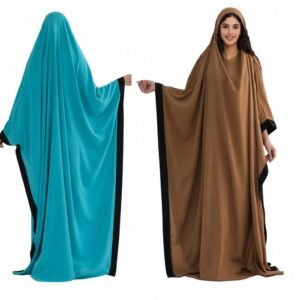
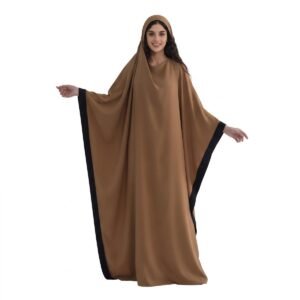
| One-piece hooded jilbab | Hood sewn into the neckline, flat-lay or structured with an internal facing | The most common format for traditional modest fashion markets | Hood styles add 3–5 days |
| Two-piece set | Outer garment + headscarf (rectangle, square or pre-sewn triangle) | Gifting and retail SKUs with a higher perceived value | Both pieces cut from the same fabric batch |
| Zip front | Zip from neckline to hem | Daily wear — working and commuting customers in the UK and US | On and off without disturbing the headscarf |
| Button front | Hidden or visible buttons, covered or fabric-matched | Eid collections and boutique brands at mid-to-premium prices | Placket checked so the hood stays centred |
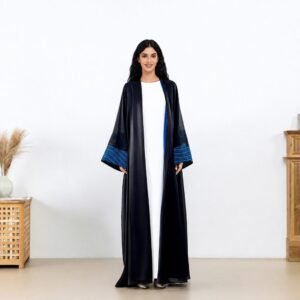
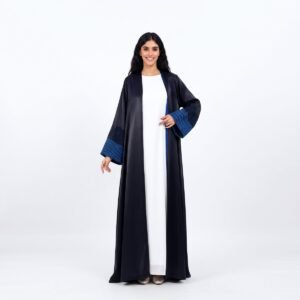
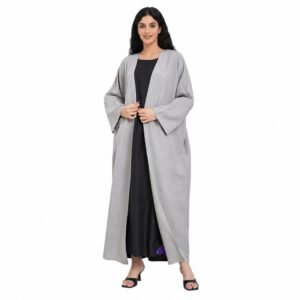
| Wrap / open front | Open front, worn with a separate hijab and inner dress | Brands that sell the style as a jilbab in Southeast Asia | Sits between a jilbab and an abaya in construction |
| Jilbab + inner dress | Outer jilbab, attached or separate hood, with a long inner dress | Ramadan and Eid collections | The most complex; 5–7 days longer than single pieces |







Jilbab Fabrics: Which Ones Hold a Hood
A jilbab needs a fabric that holds its structure at the hood and front panel. Drape-heavy fabrics open at the front in wind or movement. How the usual fabrics compare:
| Fabric | Hood and structure | Opacity | Best for |
|---|---|---|---|
| Nida crepe | Holds a hood and front closure cleanly without lining | Fully opaque | The standard jilbab fabric; Gulf and UK; 30+ colours |
| Korean crepe | Softer; suits button-front and wrap styles with more movement | Similar to nida | Customers who want a less stiff drape |
| Polyester wool blend | Structured and warm | Opaque | Autumn/winter ranges for the UK and northern Europe; adds about 15–20% to FOB |
| Cotton-modal blend | Soft and breathable | Lower — the body is usually lined | Summer jilbabs for Southeast Asian and Gulf markets |
| Linen blend | Does not hold a hood as cleanly as crepe | Varies | Open-front and wrap lifestyle styles |
| Satin | Not recommended for hooded or everyday styles | Varies | Eid, wedding and occasion jilbabs only |
Quality Control — What We Check Specifically for Jilbab
Three inspection points are specific to jilbab production that do not apply to standard abaya QC:
Hood Depth & Front-to-Nape
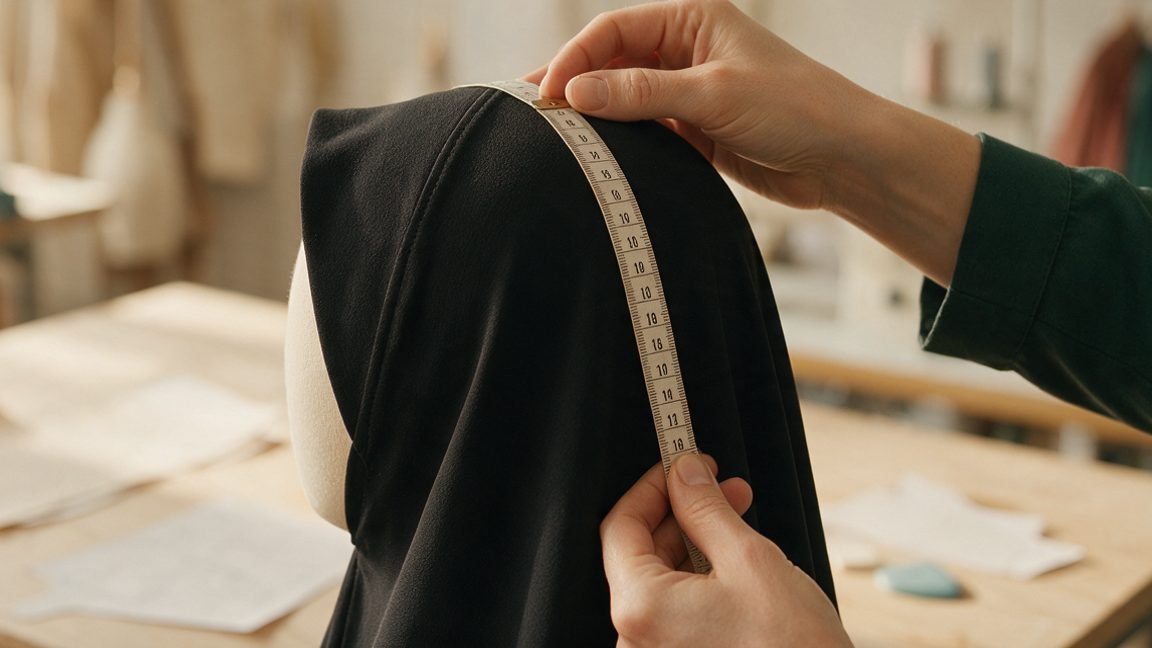
The failure buyers report most often is a hood proportioned for an abaya and added to a full-body garment — too flat, or set too far back. Every jilbab is measured on a head form at proto stage against the front-to-nape and hood-depth spec for that style. If the frame sits back from the face or the hood collapses at the crown, the pattern is corrected before cutting.
Coverage in Motion
Coverage is checked standing still and again with the arms raised and the body turned. The hem sweep and the way the front panel closes over the chest are what decide whether the garment still covers when walking or in wind. A jilbab that reads as full coverage on a mannequin can open at the side seam in motion — this is the check that catches it.
Hood-to-Closure Integration
On zippered and button-front jilbabs the closure runs from neckline to hem, so any tension in the placket pulls the hood off-centre once it is fastened. Each closure style is closed fully on the form and the hood re-checked for alignment. Structured hoods with an internal facing are checked for a frame that sits flat around the face.
Only after the hood, motion and closure checks does a jilbab lot go to its final AQL 2.5 inspection, run against defect thresholds agreed in writing before production.
If a lot fails, the choice is yours: rework at our cost, or a credit. That is in the sales agreement, and the balance is never due on a failed lot. If your market or buyer needs a third-party inspector, the visit goes into the calendar before the run starts — SGS, Bureau Veritas and Intertek have all inspected on our floor.
What You Can Customise on a Jilbab
Every element is adjustable. The two that matter most are the hood and the front closure — they decide how the jilbab covers and how easy it is to wear every day.
Attached flat, structured with an internal facing, internal drawstring or elastic finish. The hood decides how the jilbab frames the face and covers the chest.
Hidden or exposed zip, covered or fabric-matched buttons, magnetic snaps, or an open front for layering.
Fitted, wide, tulip or elasticated cuff, set to how your customers pray and move.
Floor length, midi, or your own centimetre spec, graded per size.
Side-seam, hidden or patch pockets — a small detail customers notice on a daily-wear jilbab.
Hem border, cuff trim or hood edge, tonal or contrast.
Full body, partial or unlined, depending on the fabric’s opacity.
Pantone matching, or 30+ stock colours in nida and Korean crepe.
A matching headscarf or inner maxi dress cut from the same fabric batch.
Woven care labels, hang tags and custom packaging in your brand.
OEM vs ODM vs Private Label for Jilbabs
If you are launching private label jilbabs, start from our library. If the hood or closure is what customers will buy you for, develop it as OEM.
| OEM — Your Own Design | ODM — Modify Our Base Styles | Private Label | |
|---|---|---|---|
| What you supply | Tech pack, sketch or reference garment | A style from our jilbab library | Your labels and packaging |
| What we change | Pattern, hood, closure, fabric — everything | Fabric, colour, closure type or hood design | Label and packaging only |
| Development time | A new hood-and-closure pattern takes 2–4 weeks to build, and the sample lands 7–10 days after that. | 7–10 days for a sample on one of our jilbab blocks | Just the label artwork |
| Who owns the design | The hood and closure pattern is yours alone for 12 months, in writing | Your changes are yours; our base jilbab stays in the library | Shared — the same base can carry other labels |
| Best for | Brands whose hood or closure is the point of difference | Faster launch with a shorter sampling cycle | Launching a jilbab range without development investment |
How a Jilbab Order Runs, Step by Step
Six stages, all of them on our own floor. Nothing below is outsourced to a workshop we do not control, which is why the dates on this page are dates we can hold.
Send a tech pack, a sketch or a jilbab you want to improve on, with your market, target retail price and the date you need stock. Tell us the hood and closure you want. You get fabric options and an indicative price, usually within one business day.
A proto takes 7–10 days; an OEM pattern takes 2–4 weeks to develop first. Before bulk cutting we check the assembled jilbab in daylight for opacity, hang it on a mannequin to check the hem is level, and check that the front edges line up. The sample fee is credited against your production order.
Quantities, sizes, colours and price go into a written agreement, and the price does not change mid-order. Production starts on a 30% deposit; the 70% balance is due before shipment.
25–35 days post-approval, plus 3–5 days if your style carries an attached hood or a structured closure. Inline checks through cutting and sewing, a documented 3-point inspection at 30% completion, and a final AQL 2.5 inspection before packing. Every check is photographed.
DDP with duty included, or FOB/CIF with your own forwarder. By air, jilbabs arrive in 7–12 days door to door; by sea, in 25–40 days depending on destination. Commercial invoice, packing list and certificate of origin come with every shipment.
Your jilbab pattern, spec and approved shade band are kept on file. A reorder skips pattern development, so it is shorter than the first run, and it is matched against your physical approved sample, not a description.
Shipping Jilbabs — DDP, Duties and Payment
Shipping. Most jilbab buyers take DDP: import duty is worked out and included in your quotation from the start, so you have one landed price and no customs bill later. If you clear your own goods, we work on FOB or CIF with your forwarder. By air, jilbabs arrive in 7–12 days door to door; by sea, in 25–40 days depending on destination.
Duties. A jilbab is classed as a woven women’s garment, and the duty rate depends on where it lands and what the fabric is made of. We confirm the HS classification and the rate in writing on your quotation, before you agree a price.
Payment. The 30% deposit starts production. The 70% balance falls due only when your jilbabs are finished and photographed, before they ship. Orders are paid by bank transfer; sample fees can go on PayPal or card. We issue documents in the name you nominate and can work through your sourcing agent.
Frequently Asked Questions
Factory-Direct vs Trading Company
This is the most useful table on the page. Search for a jilbab manufacturer and most of what you find will be a trading company, a sourcing agent, or a headscarf workshop quoting a full-body garment it does not cut. Both models can work, but they are not the same product, and the difference shows up in unit cost, in reorder consistency and — most of all — in what happens the first time something goes wrong.
| What you are comparing | ModestRise — Factory | Trading company / agent |
|---|---|---|
| Who physically makes the jilbab | We do — on our own lines | A third-party workshop they do not control |
| Who you speak to | Our merchandiser, who sits next to production | A salesperson who relays your question onward |
| Cost structure | No intermediary margin — you pay for material and labour | Typically 8–20% added on top of the factory price, undisclosed |
| Sample speed | 7–10 days, made on the line that will run bulk | Slower, and often made by a different workshop from bulk |
| Spec changes mid-production | Assessed and actioned directly; we can stop a lay | Negotiated through a third party who may refuse |
| QC access | AQL 2.5 in-house, photographed, images sent to you | Whatever the third-party workshop chooses to send |
| Third-party audit | Welcome — you or your agent can inspect our floor | Often resisted, because the floor is not theirs to show |
| Peak-season capacity | Lines booked against our own calendar | You compete with that agent’s other clients for the same external line |
| Reorder consistency | Pattern, marker and shade band archived against your account | May go to a different workshop on the second order |
| Design confidentiality | OEM designs written into the sales agreement as yours alone for 12 months | Hard to guarantee across workshops you cannot see |
| When a defect appears | Our own defect — you choose rework at our cost or a credit | Dependent on whether the agent can push the workshop |
| Best for | Buyers who want cost control and consistent reorders | Very small first tests, or buyers who genuinely need multi-category sourcing |
A trader is sometimes the right call, and we will say so. If you need forty categories in one container — jilbabs, home textiles, kitchen goods, stationery — a sourcing agent earns their margin by managing that complexity, and a single-product factory cannot. If you want a 30-piece test before committing to anything, a trader who can spread it across several workshops may be your only route. What we would push back on is using a trader for a product we make in-house, paying their margin, and then finding in month four that the reorder came out of a different workshop in a different shade.
Related Manufacturing Pages
Jilbab is one silhouette out of many ModestRise produces in-house. If you carry neighbouring products, the links below lead to them — cut and inspected on the same lines.
The closest silhouette to a jilbab — same construction discipline, different closure.
Bulk pricing, tiered MOQ and container-level order planning.
Matching two-piece sets with a coordinated hijab or khimar.
The head-covering layer worn with a jilbab, cut in the same house.
Front-open styling for layering over dresses and sets.
One-piece pull-on headscarves for the markets that use jilbab to mean headscarf.
The full modest dress range, including prayer dresses and kaftans.
The complete ModestRise capability overview across every category.
Get a Jilbab Wholesale Quote or Sample
Why Request a Quote From Us
- ✓Low MOQ — from 50 pcs per style/colour
- ✓OEKO-TEX® Standard 100 & GRS 4.0 certified fabrics available on request — including the nida crepe most jilbab buyers order
- ✓Full OEM / ODM & Private Label — your design, labels & packaging, hood and closure pattern included
- ✓DDP worldwide shipping — door to door, duty included
- ✓We reply with pricing usually within one business day
What to Include in Your Inquiry
- Style / construction (one-piece with attached hood, two-piece set, open-front)
- Order quantity per style/color
- Preferred fabric or material
- Branding needs (custom label, hangtag, packaging)
- Target price range
A photo of the hood coverage you want answers half our questions before you write anything.