
Most suppliers list khimar as a hijab variant. The construction is different enough that this matters.
A khimar is not a long hijab. How the garment sits on the head, how the lower portion hangs, and how much the fabric weight affects coverage are all specific to the khimar construction — and the difference shows the moment the wearer walks.
Buyers who source khimars from general hijab suppliers often receive garments where the face frame is designed for a wrapped scarf — too flat, positioned incorrectly for a straight-hang garment — and the lower fabric pools rather than falls cleanly.
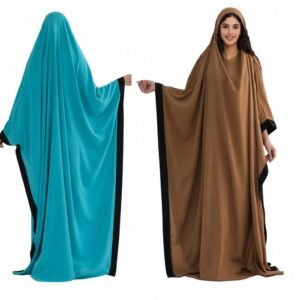
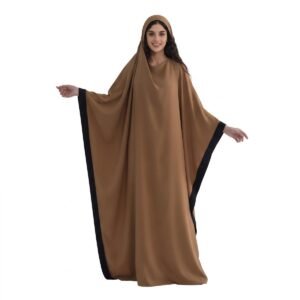
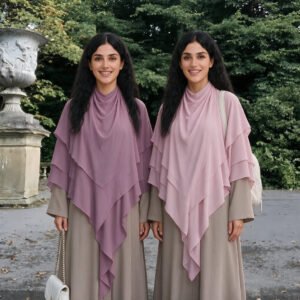
The distinguishing feature of a well-made khimar is the crown-to-hem fall: the fabric should hang in one clean line from the top of the head, not pull backward or fan out sideways. Achieving this depends on how the crown panel is cut and how the face frame is structured — details that are invisible until the garment is worn.
When brands bring us khimars from another supplier to fix, the problems are usually the same: a crown and face frame shaped so poorly that the khimar slides back on the head, panels cut off-line so the fabric never falls cleanly, and a cloth too thin for the length it has to cover.
On the roll the fabric looked right. The discomfort came later, in the cut and the stitch line, once it had been worn through a day or a prayer.
Chiffon khimars are the most requested style, but the fabric weight decision is more consequential here than for any other headwear style. At 60 gsm the khimar loses structure and clings; at 90 gsm it falls too stiffly. We standardise on 75–80 gsm for everyday chiffon khimars — it is the range buyers settle on after testing lighter and heavier grades.
| Production Specifications | |
|---|---|
| MOQ | 50 pcs / style / color |
| Price range | From $6 FOB |
| Sample lead time | 7–10 days |
| Bulk production | 20–30 days post-approval |
| Embroidered styles | +5–10 days |
| Certifications | OEKO-TEX®, GRS, BSCI, ISO 9001 |
| Shipping | DDP (US, UK, EU, UAE, MY, AU) |
| Payment | 30% deposit / 70% pre-shipment |

What Khimar Wearers Complain About
The complaints women post about khimars are remarkably consistent, and almost every one of them traces back to a construction decision a factory makes before cutting. Here is what they say, and what to put in your specification so your customers do not say it about yours.
| What wearers say | What to specify |
|---|---|
| “Whenever I’m in sujood, my khimar will drop down over my face. The inner side will also come up and then I can’t breathe and also my hair is showing.” — r/Hijabis | A face frame that holds its position: an elasticated or sewn-facing edge, or a tie-back, plus a hidden grip band at the crown — a strip of cotton jersey or silicone-dotted tape. Test the sample in prostration, not just standing. |
| “Whenever my undercap slips, it’s usually because it’s too small.” — r/Hijabis | If you sell a two-piece khimar, size the undercap for real hair volume, not a mannequin head, and offer a short and a long cap. |
| “You definitely want to avoid multi-layer or thicker fabric khimars for summer.” — r/Hijabis | A single-layer summer version in a breathable fabric such as viscose or modal, alongside the layered chiffon styles. |
| “I hate how clingy and thick the fabric is.” — r/Hijabis | Fabric weight matched to length: we work to 75–80 gsm on everyday chiffon khimars, and move longer styles to an opaque crepe instead of stacking chiffon layers. |
Ready-stock khimars or your own?
If you only want to test a few colours, wholesalers selling khimars from stock with no minimum and fast dispatch are the quicker route. Choose a factory for wholesale khimars when you need the fixes in the table above built into your own pattern, your own colours and your label — from 50 pieces per style and colour.
How We Check a Khimar Before It Ships
As a khimar manufacturer we place every style on a head form and check it for straight crown-to-hem fall. A khimar that pulls backward or fans sideways when worn indicates a crown panel cut or seam placement issue — caught at proto sample stage, not after bulk production.
Face Frame Symmetry
The most common fault on khimars sourced from general hijab suppliers is a face frame built for a wrapped scarf — too flat, and set at the wrong angle for a garment that hangs straight. The frame is measured on both sides against the pattern at proto stage, and the front edge is checked for a clean line rather than a fold.
Crown Panel Cut & Seam Placement
Whether the fabric falls in one clean line or pulls backward comes down to how the crown panel is cut and where the seams land. Each style is checked on the head form with the seam line centred; a khimar that fans sideways at the shoulder indicates the crown panel is off-grain, which is corrected at pattern stage rather than in the finished goods.
Fabric Weight Consistency
Chiffon behaviour changes sharply with weight — at 60 gsm a khimar loses structure and clings, at 90 gsm it falls too stiffly. We standardise on 75–80 gsm for everyday chiffon khimars and verify the mill's gsm per lot against the approved sample, so a repeat order hangs the same as the first one.
Once the fall, face-frame and gsm checks pass, every khimar order still goes through our AQL 2.5 final inspection, against defect thresholds agreed in writing before production. A lot that falls outside them is remade, or compensated as confirmed on your order. If your buyer nominates an inspector, we fit the visit into the calendar before cutting starts — SGS, Bureau Veritas and Intertek have all inspected on our floor.
Khimar Lengths and What Each One Needs
Length is the first decision on a khimar, because it decides the fabric weight, the lining and the lead time. Five lengths and constructions, side by side:
| Length / style | Where it ends | Fabric that works | Where it sells | Production note |
|---|---|---|---|---|
| Short | Just past the shoulders | Chiffon at 75–80 gsm | The most widely worn everyday style; Western markets | Standard lead time |
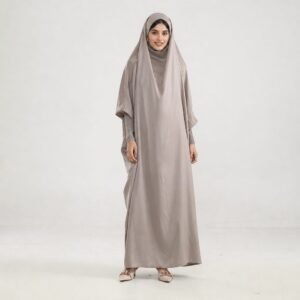
| Medium | Mid-chest to waist — covers the décolletage without a separate chest cover | Chiffon, Korean crepe; satin for occasion styles | Gulf and North African buyers, where chest coverage is required | Straight hem or a slight A-line flare |
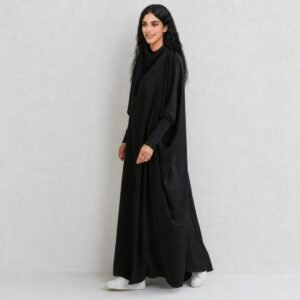
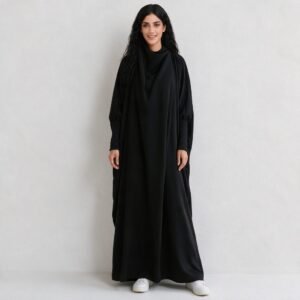
| Long | Waist, hip or knee | Nida crepe, or chiffon with a lining | More conservative markets | 3–5 days longer than short styles |
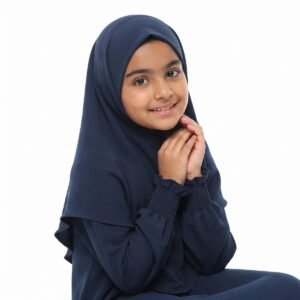
| Triangle / Amira | Pre-sewn triangle that sits symmetrically, no adjustment | As specified | Children’s khimars and ranges that need one repeatable look | Consistent shape across a wholesale run |
| Embroidered / embellished | Any of the above, with work on the face frame, hem border or front panel | Chiffon, nida or satin | Eid and occasion collections; crystals or beads on the face frame | Adds 5–10 days |







Single-Piece Khimar or Two-Piece With Undercap?
Whether a khimar stays put depends on what it sits on. That is the real choice between a single-piece khimar and a two-piece set.
| Single-piece khimar | Two-piece with undercap | |
|---|---|---|
| What holds it in place | The crown cut and face frame, plus an optional hidden grip band at the crown | The undercap, which gives the khimar a base and stops it slipping on different hair types |
| Suits | Customers who already wear their own undercap | Buyers in the UK and US, where a single-piece khimar does not hold for every customer |
| What to specify | Face-frame finish (elasticated, faced or tie-back) and whether to add the grip band | Undercap in matching jersey or cotton-modal, sized for real hair volume, in a short and a long version |
| Prayer check | Tested in sujood as well as standing | The khimar is still tested in sujood; the undercap is checked for slipping at the hairline |
If you sell both, the undercap can also go on sale as its own SKU in the same colours.
Khimar Fabrics by Weight and Length
Too light and a khimar clings; too heavy and it pulls the face frame backward. The right fabric also changes with length — a waist-length chiffon khimar behaves very differently from a shoulder-length one.
| Fabric | Feel and opacity | Best at | Avoid for |
|---|---|---|---|
| Chiffon, 75–80 gsm | Light and flowing, semi-transparent; 40+ colours | Short and medium everyday khimars | Long styles without a lining; below 60 gsm it clings, above 90 gsm it falls stiffly |
| Nida crepe | Fully opaque, matte, medium weight | Long khimars, structured crowns, Gulf markets | Customers who want a light, floaty fall |
| Korean crepe | Softer than nida, similar opacity, a little lighter | Medium lengths for Western markets | — |
| Jersey | Stretch, no pins needed | Undercaps and sports khimars | Draped outer khimars — it lacks the fall of a woven fabric |
| Satin | High sheen, heavy | Short and medium occasion khimars for Eid and weddings | Waist length and longer without a structured lining |
| Viscose / modal | Breathable, soft natural feel | Single-layer summer khimars; eco-minded Western brands | Tight budgets — slightly dearer than polyester |
What You Can Customise on a Khimar
Length and face-frame construction are the two decisions that most affect how a khimar wears. Everything else — colour, embellishment, branding — comes after getting these right.
Shoulder, chest, waist, hip or knee, or your own centimetre spec. Length decides the fabric weight, so it is the first thing to fix.
Open, elasticated edge, sewn facing, ruched or drawstring. This is what keeps a khimar in place during prayer.
Standard dome, or structured with an internal facing for a cleaner fall from the top of the head.
A hidden grip band at the crown — cotton jersey strip or silicone-dotted tape — for styles that must not slide back.
Straight, curved, scalloped or split front, cut so the lower fabric falls instead of pooling.
Full body, front panel only, or unlined for opaque fabrics such as nida.
Face-frame border, hem edge or full front panel; crystals or beads on the face frame for occasion styles.
Pantone matching, or 40+ stock colours in chiffon and nida.
Matching jersey or cotton-modal undercap, short or long, for two-piece styles.
Woven labels, care labels, hang tags and packaging in your brand.
OEM vs ODM vs Private Label for Khimars
Three ways to put your name on a khimar range. Private label khimars are the quickest to launch; OEM is the route when your crown or face frame is what sets you apart.
| OEM — Your Own Design | ODM — Modify Our Base Styles | Private Label | |
|---|---|---|---|
| What you supply | Tech pack, measurement spec or reference sample | A style from our khimar library | Your woven labels and packaging |
| What we change | Everything: pattern, crown, face frame, fabric | Fabric, length, face-frame treatment or embellishment | Label and packaging only |
| Development time | Crown and face-frame development runs 2–4 weeks, then allow another 7–10 days for the sample. | A 7–10 day sample on our base block | Only the label artwork to approve |
| Who owns the design | Your crown, face-frame and length pattern, reserved for you for 12 months in writing | Your changes are yours; the base khimar stays in our library | Shared — other buyers can label the same base khimar |
| Best for | Brands with specific crown or coverage requirements | Brands entering the khimar category for the first time | Retailers adding khimars to an existing range |
Frequently Asked Questions
Related Products
Muslim Prayer Dress
One-piece and two-piece prayer garments, including khimar-length styles.
Jilbab Manufacturer
Fixed-hood and open-front jilbabs with a matching inner scarf.
Instant Hijab Manufacturer
Pull-on, no-pin headwear — the everyday counterpart to a khimar.
Abaya Manufacturer
Closed, open, embroidered and luxury abayas from the same floor.
Get a Khimar Wholesale Quote or Sample
Why Request a Quote From Us
- ✓Low MOQ — from 50 pcs per style/colour
- ✓OEKO-TEX® Standard 100 & GRS 4.0 certified fabrics available on request — chiffon, crepe and jersey included
- ✓Full OEM / ODM & Private Label — your design, labels & packaging, crown and face frame included
- ✓DDP worldwide shipping — door to door, duty included
- ✓We reply with pricing usually within 8–12 hours
What to Include in Your Inquiry
- Khimar length (short, medium, long, triangle or embellished)
- Order quantity per style/color
- Preferred fabric or material
- Branding needs (custom label, hangtag, packaging)
- Target price range
A photo showing the length and the face frame you want is worth more than a paragraph.