

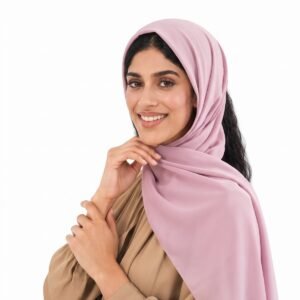


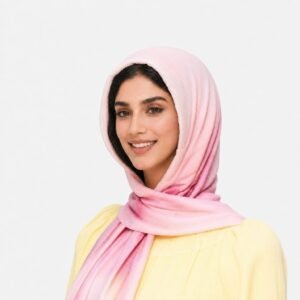

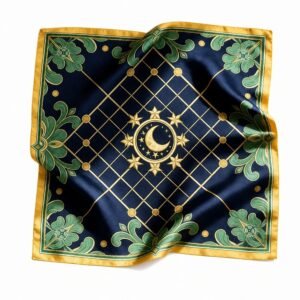

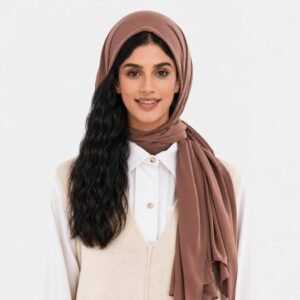


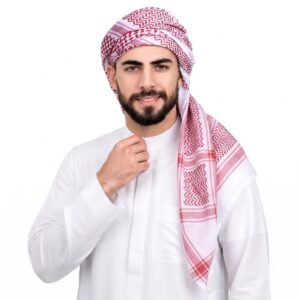
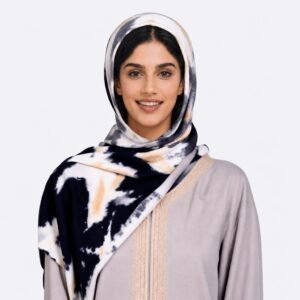



Jersey Hijab (Rectangle & Square)
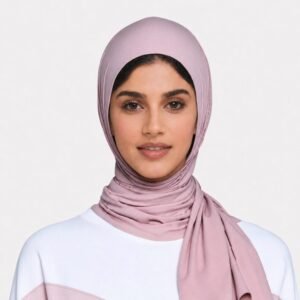
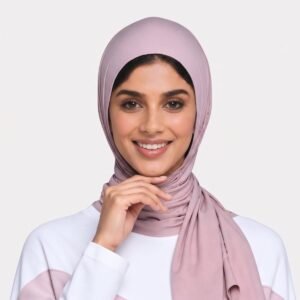
The volume product in almost every market, and the one that converts best for a new hijab brand, because jersey forgives. It stretches, so it does not need pinning, and it does not slide off the way chiffon does. It also survives a customer’s washing machine — which is why repeat purchase rates on jersey outsell every other fabric in Western and Southeast Asian markets. We sell it as a plain rectangle, as a two-piece set with a matching underscarf, or as a square for layered styles.
Construction notes: jersey is a knit, so the edge is finished with a 3-thread overlock or a narrow cover stitch rather than a rolled hem — a rolled hem on jersey will not sit flat and will pucker along the length. We run the overlock at 12–14 stitches per inch with a lightweight spun-poly thread matched to the fabric shade, because a contrasting thread on a stretch edge telegraphs every tension fluctuation. For the no-pin jersey format we add a hidden elastic or silicone grip strip inside the front band; the strip must be anchored with a twin-needle stitch, not glued, or it releases after three or four washes. Corners are the tell on a jersey rectangle — a mis-clipped corner pulls round and the hijab hangs off-centre. We clip to a jig, not by eye.
Typical fabric: cotton-jersey blend 180–220 g/m², viscose jersey, bamboo jersey, modal blends.
Chiffon Hijab (Plain, Printed & Embroidered)
The bestselling hijab fabric globally and the one buyers ask for by name. Chiffon gives the drape, the movement and the soft matte-to-slight-sheen surface that photographs well on a person and hangs cleanly around the shoulders. It is also the fabric that punishes poor workmanship hardest, because the hem is where a chiffon hijab lives or dies. Plain chiffon in a stocked colour is the fastest route to market; printed and embroidered chiffon is where brands build identity.
Construction notes: chiffon edges are finished with a rolled hem — a 3-thread overlock that rolls the raw edge under itself, typically at a 2–3 mm roll width. The roll must be consistent along the entire perimeter; if the machine tension drifts, the edge goes wavy and the hijab will not lie flat when wrapped. We set the differential feed separately for the length and the width of each panel, because the long edge and the cross edge feed at different rates on a 190 cm run. Needle size matters on fine chiffon: a needle that is one size too heavy leaves visible needle holes along the hem that never close. Print registration on chiffon also shifts during finishing — we print on a stabilised panel and check registration after the hem is set, not before.
Typical fabric: polyester chiffon 60–90 g/m², premium soft-touch chiffon, crinkle chiffon, pearl chiffon, printed chiffon.
Instant Hijab / One-Piece Pre-Sewn
Ready-to-wear, no pins, no styling skill required — the format that opens the hijab category to mainstream retailers, airport retail, gifting and travel. An instant hijab is a cap and a tube joined into a single garment, sometimes with a built-in underscarf layer, so the customer pulls it over her head and is finished in three seconds. It is the highest-value hijab format per piece and the most expensive to make, and the gap between a good one and a bad one is entirely in the pattern, not the fabric.
Construction notes: an instant hijab has four places where it fails. First, the head opening: if the cap and the tube are joined at the wrong angle, the front edge twists to one side when worn, and no amount of pressing fixes it — this is a pattern problem and it is why we cut a wear trial on a mannequin before approving the block. Second, the face opening: it must be faced or bound so the edge does not stretch out, and the binding must be cut on the cross grain or it will not follow the curve. Third, the join seam between cap and tube sits against the hairline, so it must be flat-felled or overlocked and pressed open, never left as a raw overlock. Fourth, the inner grip band must be positioned so it sits at the hairline, not on the forehead, or the hijab rides back. Sewing time on an instant hijab runs 11–14 minutes against 4–5 minutes for a plain rectangle, which is where the price difference comes from.
Typical fabric: jersey, viscose jersey, modal, soft chiffon with a jersey inner, bamboo blend.
Khimar (Two-Piece & Full-Length)
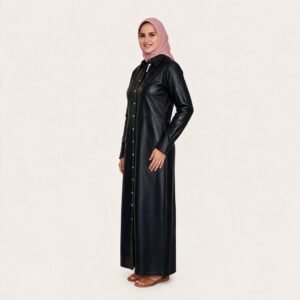
A single garment that covers the head and falls over the shoulders and chest to hip or knee length — the everyday format across the Gulf, North Africa and parts of Southeast Asia. The khimar is ordered in two constructions: a true one-piece (cap and body cut as one continuous panel) and a two-piece (a fitted cap plus a separate flowing body). The two-piece is easier to grade and easier for the wearer to adjust; the one-piece gives a cleaner line and commands a higher price.
Construction notes: the body width at the hem is the number that defines the look — a straight khimar at 90 cm width reads as modest and practical, a 140–160 cm hem flare reads as occasion wear, and the flare is created by inserting panels on the correct grain or the hem will spiral. Length runs 90–130 cm from the crown, and because the garment is long and light, hem levelness has to be checked on a mannequin rather than on a table: a khimar hem that measures perfectly level flat can hang visibly uneven once gravity and grain deviation take over. Face opening is finished with a faced band or a bound edge, and we always sample the neckline on a live model or a head form before bulk.
Typical fabric: nida, Korean crepe, chiffon with lining, jersey, moss crepe, satin for occasion lines.
Shawl, Wrap & Pashmina-Style
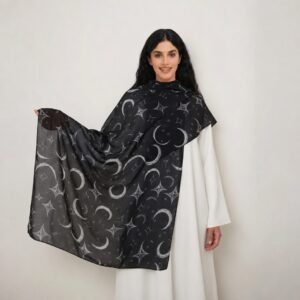
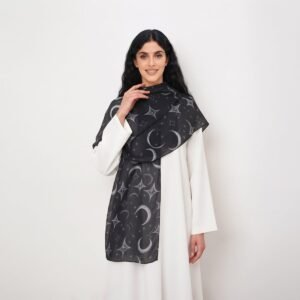
The long-format piece — a wide rectangle worn draped over one or both shoulders, often over a hijab as a layering element. Shawls sit at the top of the price ladder in most ranges because they use the most fabric per unit and because the market treats them as a fashion item rather than a basic. Bridal, Eid and evening collections are almost entirely shawl territory, and they are the pieces customers photograph and tag.
Construction notes: shawl sizes run well beyond a standard hijab — 200×70 cm and 200×100 cm are the two commercial standards, with wider bridal versions to 220×110 cm. Fabric consumption is 2.5–3.5 times a rectangle hijab, which is what drives the price. Edge finishing defines the tier: a plain rolled hem is the entry option, a hand-rolled hem with an invisible stitch is the boutique option, and a hand-knotted or twisted fringe is the luxury option and is priced per metre of edging because it is done by hand. Tassels and fringes must be attached after the hem is set and secured with a bar tack, or the first dry clean will strip them. On satin and silk-blend shawls we specify a hand-finished hem because a machine hem on a lustrous fabric will read as a hard line under any light.
Typical fabric: satin, silk-blend satin, charmeuse, pashmina-style viscose blends, wool blends for winter, crinkle chiffon.
Sport Hijab (Performance & Activewear)
Pull-on, snug, moisture-wicking and non-slip — built to stay in place through running, gym work, swimming and team sport. The sports hijab is the fastest-growing hijab format in Western markets and the one with the strictest functional spec, because a sport hijab that slides during activity is returned regardless of how good it looks. Sold on its own or bundled with a modest activewear set as a single SKU.
Construction notes: sport hijabs are knit from 4-way stretch performance fabric, typically 200–260 g/m² with 18–25% elastane, so the piece holds its shape through a wash cycle and returns to size. The inner grip band is the critical component: a silicone print or a silicone-lined elastic strip positioned along the hairline and around the back of the neck, applied with heat transfer and tested after five wash cycles for adhesion — a glued band delaminates and the product fails. Mesh venting is placed behind the ear and at the nape, using a bonded or flatlock construction that does not add bulk under a helmet. Two-piece sport hijabs pair a fitted cap with a separate drape so the athlete can adjust coverage without removing the base layer. All seams are flatlock or cover-stitched; a standard overlock seam on a sport hijab creates a ridge that rubs within twenty minutes of wear.
Typical fabric: polyester-spandex performance knit, nylon-spandex, recycled GRS performance jersey, mesh panels.
Kids Hijab (One-Piece & Pull-On)
A genuinely separate pattern block, not a scaled-down adult hijab. Children's proportions across the head and neck are different, and a kids hijab that is simply a smaller rectangle will not stay on an active child for a school day. Most kids lines are sold as one-piece pull-on formats with an elasticated or relaxed cap, in soft fabrics that do not itch at the hairline.
Construction notes: commercial kids sizes run 100×50 cm and 120×60 cm for the wrap formats, and S/M/L caps for pull-on formats, covering roughly ages 2–8. The elasticated cap must be sized so it grips without marking the forehead — we use a soft 8–10 mm elastic set into a casing rather than exposed elastic, and we test the opening on a child-sized head form. Fabrics need to be softer and lighter than adult equivalents: a 220 g/m² adult jersey is too heavy and too warm on a child, so we specify 150–180 g/m². Kids pieces are washed more often than any other category, so colour fastness is critical — we require a minimum grade 4 on both wash and crock testing for every kids colour, and we reinforce the cap-to-tube join because it is the first thing to fail on a pull-on kids hijab.
Typical fabric: cotton jersey, bamboo jersey, modal, soft viscose jersey, lightweight cotton voile.
Underscarf, Bonnet & Inner Cap
The base layer sold underneath everything else — the highest-frequency repeat order in the hijab category because customers buy them in multiples and replace them far more often than an outer hijab. Bonnets and underscarves are what a brand uses to lift average order value: they share the colour library with the outer hijabs, cost little to produce, and turn a single-item purchase into a set. Volumising bonnets, tie-back caps, pull-on tube caps and full-coverage sleep bonnets all run on the same production line.
Construction notes: underscarves are deceptively technical. The fabric must be thin enough not to add bulk under an outer hijab but opaque enough not to show hair, which is why we work in 110–160 g/m² rather than the 180 g/m² used for outer pieces. The edge must be finished with a soft band or a flat overlock — any ridge along the hairline shows through the outer hijab as a line across the forehead. Tie-back formats need the ties cut on the bias so they knot without rolling, and the tie attachment must be bar-tacked, not single-stitched. Volumising bonnets use a gathered or pleated crown, and the gathers must be distributed evenly across the crown arc: uneven gathering is the single most common complaint on this product and is caught in our inline check, not in final inspection. A sleepless-bonnet or satin-lined variant needs the lining attached with a French or bound seam so the satin does not fray against the hair.
Typical fabric: cotton jersey, bamboo, modal, viscose jersey, satin-lined jersey, mesh.